
That kind of pressure makes one planning document more important than ever: the target product profile, or TPP. It's the blueprint that forces scientific, regulatory, and commercial teams to agree on what "success" actually looks like before the first patient is ever dosed.
This guide breaks down what a TPP is, its core components, how it changes shape as a program matures, and how the right development partner keeps it executable across global markets.
Key Takeaways
- A TPP defines minimum, base-case, and aspirational goals for drug approval.
- It aligns clinical, regulatory, and commercial teams around one shared blueprint.
- TPPs gain detail and rigor as programs advance from preclinical work to Phase III.
- FDA, EMA, and WHO all lean on TPP-style frameworks for dossier review and prioritization.
- DRK Research Solutions turns TPPs into compliant, region-specific trial strategies.
What Is a Target Product Profile?
A target product profile is a strategic planning document that spells out the characteristics a drug candidate needs to achieve before and during development. The concept originates from FDA guidance, which describes the TPP as a voluntary, dynamic summary of a development program expressed in labeling concepts, essentially a draft of the future drug label built backward from the goals a sponsor wants to hit.
According to the FDA's draft guidance on target product profiles, the document isn't a binding commitment. It's a communication tool meant to structure sponsor-agency conversations throughout the program.
A well-built TPP typically defines:
- Intended use and indication: the specific condition or population the drug is meant to treat
- Target population: patient demographics, disease severity, and any relevant subgroups
- Desired efficacy and safety attributes: structured as minimum acceptable and ideal ("stretch") targets
TPP vs. Quality Target Product Profile (QTPP)
These two terms get confused constantly, but they answer different questions. A TPP addresses the clinical and commercial picture: who the drug treats, how well it needs to work, and what safety profile is acceptable.
A QTPP, defined under ICH Q8, focuses narrowly on the physical and chemical quality attributes of the product itself, things like dissolution rate, purity, and stability that drive CMC and manufacturing strategy.
Three Audiences, Three Uses
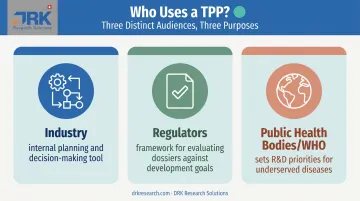
- Industry treats the TPP as an internal planning and decision-making tool.
- Regulators use it as a framework for evaluating dossiers against stated development goals.
- Public health bodies like WHO publish TPPs to set R&D priorities for diseases affecting underserved populations, specifying preferred and minimally acceptable attributes for products the world actually needs.
Missing an "essential" parameter in a TPP, such as failing a minimum efficacy bar, is often the trigger for program termination. Exceeding an "ideal" parameter, on the other hand, is what turns a merely approvable drug into a commercially valuable one.
These decisions play out against a stark attrition backdrop. Across the 2011-2020 cohort tracked by BIO, QLS, and Informa, only 7.9% of programs that entered Phase I eventually reached FDA approval.
A clearly defined TPP won't single-handedly change that math, but it does give teams an early, honest checkpoint for deciding whether a program is still worth the investment.
Key Components of a Well-Constructed TPP
A TPP is only useful if it's specific enough to guide real decisions. Vague language here creates problems downstream, in protocol design, in regulatory meetings, and in commercial forecasting.
Target Population and Unmet Need
Define the patient segment precisely: disease stage, prior treatment history, age range, and any biomarker requirements. Quantify the epidemiology, incidence, prevalence, and the size of the treatment gap, so the commercial case is grounded in numbers, not assumptions.
Efficacy Endpoints
Pull endpoints from validated, FDA- or EMA-recognized measures with Phase III precedent whenever possible. Per ICH E8(R1), the primary endpoint must provide clinically relevant, convincing evidence supporting the drug's primary objective. Your TPP should separate primary endpoints tied directly to the core value proposition from secondary endpoints that support labeling claims or differentiation.
Safety and Risk-Benefit Profile
Map expected adverse event rates against the standard-of-care package insert for the same indication. This risk-benefit comparison directly determines whether physicians will prescribe your drug over an established alternative.
Administration, Dosage, and Differentiation
Route of administration, dosing frequency, titration requirements, and formulation all function as competitive levers. An oral once-daily dose competing against a twice-weekly injectable is a different commercial story entirely. Your TPP should articulate, in plain terms, why this product deserves a place on the market next to existing standard of care.
At DRK Research Solutions, Chief Scientific Officer Dr. Vipan Dhall and his team work alongside sponsors to translate these TPP components into scientifically rigorous, regulation-ready study designs. Their experience spans generics, hybrid products, and novel therapeutic programs across regulated markets.
How a TPP Evolves Across the Drug Development Lifecycle
A TPP written at IND stage should look nothing like the one submitted alongside your NDA. Treating it as a static document is one of the fastest ways to waste the tool entirely.
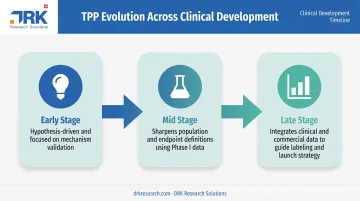
Early Stage
TPPs start as hypothesis-driven documents. They establish foundational goals amid genuine scientific uncertainty, before you know whether the mechanism will translate into clinical benefit. The FDA's own guidance acknowledges that early TPPs can and should be brief, keeping teams focused on core mechanism validation rather than premature specificity.
Mid Stage
As preclinical and Phase I data accumulate, the document sharpens. Patient population definitions get more specific, and endpoint selection gets validated against real safety and tolerability signals. This is where a rough hypothesis becomes an executable pivotal trial plan, reducing the risk of costly protocol amendments later.
Late Stage
By Phase III, the TPP integrates clinical data and commercial projections, directly shaping labeling strategy and launch planning. FDA recommends regular revision of the TPP as knowledge evolves, updating:
- Indication and patient population definitions
- Comparator selection and dosing strategy
- Safety language and risk communication
This revision extends to organizational structure, too. TPP ownership is moving away from the traditional commercial-team-led model toward integrated development-commercial collaboration that spans the entire lifecycle, not just the pre-launch phase.
Mature TPPs also build in contingency thinking: how might approval standards or standard-of-care shift five to seven years out? A 2025 peer-reviewed example illustrates this well.
Researchers reviewing five candidate TPPs for food-allergy therapies convened a patient council that favored age-based population definitions over disease-type categories, helping developers refine age cutoffs before pivotal trials began.
TPP-Driven Regulatory Strategy and Global Market Access
A well-defined TPP does more than organize internal thinking. It gives sponsors a concrete document to bring into regulatory conversations, which speeds up everything downstream.
- FDA Type B and Type C meetings rely on a clear TPP to focus discussion. PDUFA VII goals target a 21-day written response and a 60-75 day meeting scheduling window.
- EMA scientific advice and orphan protocol assistance function similarly, offering prospective, nonbinding input through 40- or 70-day procedures depending on complexity.
- WHO TPPs set preferred and minimal attributes for public-health-priority diseases, guiding developers, funders, and regulators toward products underserved populations actually need.
Reconciling these frameworks gets complicated fast, especially for orphan indications or programs targeting low- and middle-income countries where WHO Prequalification pathways matter alongside national regulatory approval.
This is where localized regulatory expertise becomes essential. DRK Research Solutions operates across Europe, the Middle East, Asia, Africa, and the Americas, helping sponsors adapt a single global TPP into region-specific, compliant trial and dossier strategies. This proves particularly valuable for underserved LMIC markets, where regulatory pathways do not always mirror FDA or EMA expectations.
TPP in Practice: Template and Real-World Example
Here's a simplified two-column example for a hypothetical oral therapy in Type 2 diabetes:
| Attribute | Minimum Acceptable | Ideal / Aspirational |
|---|---|---|
| Indication | Adjunct to metformin, second-line | First-line monotherapy option |
| Population | Adults with HbA1c 7.5-10% | Broader range including pediatric use |
| Efficacy | HbA1c reduction ≥0.5% vs. placebo | HbA1c reduction ≥1.2%, weight loss benefit |
| Safety | AE rate comparable to standard of care | Lower hypoglycemia risk than standard of care |
| Dosing | Once-daily oral tablet | Once-weekly oral option |
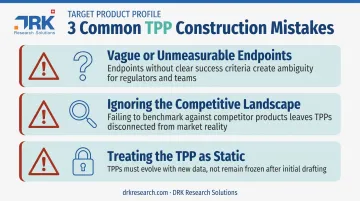
Common Construction Mistakes
- Vague or unmeasurable endpoints: "improved quality of life" means nothing without a validated scale attached
- Ignoring the competitive landscape: a TPP built in isolation from what's already approved sets the bar too low
- Treating it as static: a TPP frozen at Series A stage becomes useless by Phase III
Where AI Tools Fit (and Where They Don't)
AI adoption in drug development is accelerating. The FDA reported receiving more than 500 submissions containing AI components as of late 2024, touching areas like response prediction and dose optimization. Some teams now use AI for first-pass TPP drafting and horizon-scanning regulatory literature.
Treat these outputs as a starting point, not a finished product. Current tools are still limited by gaps in publicly available data on failed trials and proprietary commercial intelligence, meaning human scientific judgment still does the heavy lifting.
Frequently Asked Questions
What is a target product profile in drug development?
A target product profile is a strategic document outlining the minimum acceptable and ideal characteristics (indication, population, efficacy, safety, and dosing) a drug must achieve to reach approval and succeed commercially.
What does "clinical trial based on target product profile" mean?
It means the trial's endpoints, patient population, and design elements are pulled directly from the TPP's predefined efficacy and safety targets, ensuring the study can actually prove the intended profile.
What is a target in drug development?
A "target" refers to the biological molecule, a protein, gene, or receptor, that a drug is designed to interact with to produce its therapeutic effect. It's distinct from the TPP, which covers the clinical and commercial framework.
What are the five R's of drug development?
Right target, right patient, right tissue, right safety, and right commercial potential. This framework, popularized by AstraZeneca's pipeline analysis, is often used alongside a TPP to reduce attrition.
How is a TPP different from a Quality Target Product Profile (QTPP)?
A TPP addresses clinical and commercial goals. A QTPP, defined under ICH Q8, focuses on the physical and chemical quality attributes needed for manufacturing and CMC strategy.
How often should a TPP be updated during development?
Review and refine it at every major milestone, end of Phase I, end of Phase II, and pre-Phase III, as new clinical data and regulatory feedback come in. Regulatory guidance from agencies like the FDA and EMA treats the TPP as a living document, not a one-time deliverable.