

Introduction
Polypharmacy has become the default state for millions of patients managing chronic disease.
Prescription drug use among U.S. adults with chronic conditions has climbed sharply between 1999 and 2018, according to NHANES data published in a 2023 peer-reviewed analysis:
- Diabetes patients taking five or more prescription drugs: 36.3% to 57.7%
- Hypertension patients taking five or more prescription drugs: 23.3% to 40.7%
Fixed-dose combinations (FDCs) offer one practical answer to that pill burden. This article breaks down what FDCs are, their real advantages and limitations, how the FDA and EMA evaluate them, and what it takes for sponsors to bring one to market.
Interest in FDC development is accelerating, particularly for HIV, tuberculosis, cardiovascular disease, and other chronic conditions where treatment simplification matters most, especially for sponsors eyeing emerging markets.
Key Takeaways
- FDCs merge multiple active ingredients into one dosage form, cutting pill counts
- Regulators require proof that each ingredient meaningfully boosts safety or efficacy
- Real benefits aside, dose inflexibility, interactions, and formulation complexity remain hurdles
- Speedy FDC approval needs CRO/CDMO partners skilled in factorial trial design and multi-region filings
What Is a Fixed-Dose Combination (FDC)?
A fixed-dose combination is a single dosage form, such as a tablet, capsule, or injection, containing two or more active pharmaceutical ingredients in a fixed ratio. That's the working definition used by the FDA, EMA, and WHO alike, even though each agency phrases it slightly differently.
FDCs are not the same as co-packaged drugs. A co-packaged product bundles two separate final dosage forms together in one box or blister pack. The patient still swallows two pills. An FDC merges those ingredients into a single pill, capsule, or injection.
Real-World Examples Across Therapeutic Areas
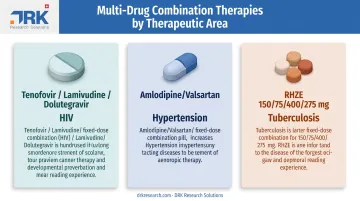
- HIV: Efavirenz/emtricitabine/tenofovir disoproxil combines three antiretrovirals into one daily tablet, authorized in the EU for virologically suppressed adults
- Hypertension: Amlodipine/valsartan (marketed as Exforge) pairs a calcium channel blocker with an angiotensin receptor blocker
- Tuberculosis: The WHO-recognized four-drug RHZE combination bundles rifampicin, isoniazid, pyrazinamide, and ethambutol at fixed strengths of 150/75/400/275 mg per tablet
The Rational Concurrent Therapy Standard
These examples show FDCs in practice, but not every combination qualifies for approval. Regulators apply a specific standard to decide which ones make sense.
Under U.S. regulation (21 CFR 300.50), a combination drug is only permitted when each component contributes to the claimed effect. The amount, frequency, and duration of each ingredient must also produce a safe, effective outcome for a population that genuinely needs concurrent treatment.
A combination built solely to counteract one drug's side effect isn't considered rational. The exception: cases where that side effect can't reasonably be managed by simply lowering the offending drug's dose.
This standard shapes every FDC development program, generic or novel. Historically, FDA approved 145 FDCs between 1980 and 2012, including 28 new molecular entities and 117 non-NME combinations. Non-NME approvals grew steadily, from 12 in the 1980s to 59 in the 2000s, showing consistent expansion over three decades.
Why Fixed-Dose Combinations Matter: Key Advantages
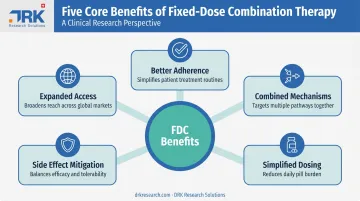
Better Adherence, Fewer Missed Doses
Fewer pills usually means better follow-through. A meta-analysis covering 9 studies and 62,481 hypertension patients found FDC therapy improved adherence by a mean of 14.92 percentage points compared to taking the same drugs separately. Persistence on therapy also favored FDCs, with a relative risk of 1.84 for staying on treatment longer, according to pooled clinical research on single-pill versus free-equivalent combinations.
That's not a universal guarantee across every disease state, but it's a consistent pattern worth building programs around.
Combining Mechanisms for Greater Effect
Amlodipine blocks calcium entry into vascular smooth muscle. Valsartan blocks angiotensin II at the AT1 receptor. Together, they lower blood pressure through two independent pathways, often achieving control that neither drug reaches alone. This is the therapeutic logic behind most rational FDCs: complementary mechanisms, not just convenience.
Simplified Dosing for Complex Patients
- Reduces the cognitive and physical burden of managing multiple prescriptions for elderly patients
- Cuts scheduling complexity for patients already juggling polypharmacy across several conditions
- Streamlines large-scale public health programs where consistent dosing across thousands of patients matters more than individual titration
Mitigating Side Effects and Misuse
Some FDCs pair an active ingredient specifically to offset another's risks. Carbidopa/levodopa blocks peripheral breakdown of levodopa, increasing the amount reaching the brain while reducing nausea and vomiting. Buprenorphine/naloxone works similarly for misuse prevention: naloxone triggers withdrawal symptoms if the combination is injected by someone dependent on full opioid agonists.
Expanding Access in Underserved Markets
Simplified regimens translate into simplified supply chains, a critical consideration in resource-limited settings. Fewer SKUs to procure, store, and distribute means fewer points of failure. That's a mission DRK Research Solutions takes seriously, given its focus on faster, more affordable therapy development for patients across LMICs in Africa, Asia, and the Middle East.
Challenges and Limitations of FDCs
FDCs aren't a universal fix. Three limitations show up repeatedly in development programs:
- Dose inflexibility. Adjusting one ingredient's dose means adjusting them all, stripping clinicians of the ability to titrate to a patient's specific response—a drawback WHO flags directly.
- Regulatory complexity. Proving each ingredient's independent contribution to safety or efficacy often demands extra trial arms and more complex statistical justification than a single-entity drug requires.
- Formulation risk. Combining multiple APIs in one dosage form can introduce drug-drug interactions, stability issues, and bioavailability challenges, especially when solubility profiles or excipients don't align.
Regulatory Requirements and Development Pathway for FDCs
Global Regulatory Frameworks Governing FDCs
The FDA's fixed-combination rule, 21 CFR 300.50, requires that every component contribute to the product's effect, and that dosing support a significant patient population genuinely needing concurrent therapy. It's the baseline every U.S. FDC application must satisfy.
The EMA runs a parallel track. Its guideline on clinical development of fixed-combination medicinal products (EMA/CHMP/158268/2017) requires a documented pharmacological and medical rationale. Sponsors must also show that each active substance contributes to efficacy or safety, with a positive overall benefit-risk balance. Both agencies land on the same core principle: prove contribution, or don't expect approval.
Evidence, Study Design, and Waivers
Factorial study designs remain the gold standard for demonstrating contribution. A typical four-arm trial compares placebo, ingredient A alone, ingredient B alone, and the combination, showing that A+B outperforms either component individually.
Feasibility drops fast as ingredient count rises. Three components already strain trial logistics, and four or more, like the TB RHZE combination, rarely support a full factorial design.
Waivers or alternative designs become relevant when:
- Monotherapy arms would expose patients to serious, irreversible harm
- Withholding one component raises ethical concerns, such as in HIV treatment where resistance risk is high
- Established regimens, pharmacologic literature, or clinically justified comparisons can substitute for new trial data
Evidence requirements also shift depending on the relationship between ingredients. Combinations targeting the same symptom typically need superiority data. Ingredients added purely to improve another's safety profile need a different evidentiary bar entirely, focused on the safety benefit itself.
The takeaway for sponsors: regulatory strategy has to start early, with scientific rationale documented before trial design begins. Engaging regulatory affairs specialists at this stage turns that rationale into a dossier that withstands agency scrutiny.
How DRK Research Solutions Supports FDC Development
Bringing an FDC from concept to market touches nearly every discipline in drug development, and that's where DRK Research Solutions fits in.
DRK's CDMO capabilities cover the full arc of generics and hybrid FDC development for regulated markets:
- Lab-scale formulation development and optimization, built around ingredient selection and risk assessment
- Analytical method development validated to ICH and USP standards
- Technology transfer to GMP-compliant manufacturing partners, including scale-up studies and on-site support
- Exhibit and commercial batch manufacturing through partner facilities compliant with FDA and EMA requirements
- eCTD dossier preparation spanning Modules 2 through 5
This formulation and regulatory work spans DRK's global footprint. With operational hubs across Europe, the Middle East, Asia, Africa, and the Americas, DRK helps sponsors navigate approval pathways that differ sharply from one region to the next. This includes WHO Prequalification routes relevant to LMIC markets.
DRK's support doesn't stop at the dossier. From Phase II-IV clinical development through CDMO manufacturing, the goal is straightforward: shorten FDC development timelines and get combination therapies to the patients who need them.

Frequently Asked Questions
What is the difference between a fixed-dose combination and a co-packaged drug?
An FDC merges two or more active ingredients into one dosage form, like a single tablet. A co-packaged drug keeps the ingredients in separate final products bundled together in one package.
What are some common examples of fixed-dose combination medicines?
Common examples include antiretroviral combinations for HIV, amlodipine/valsartan for hypertension, and the four-drug RHZE combination for tuberculosis. Each merges complementary or synergistic ingredients into a single dose.
What are the main advantages of fixed-dose combinations?
FDCs improve adherence by reducing pill burden and simplifying dosing schedules for patients on multiple medications. They can also produce greater therapeutic effect through complementary mechanisms of action.
What evidence is required to get an FDC approved by regulators?
Sponsors must demonstrate that each active ingredient independently contributes to safety or effectiveness. This typically requires factorial clinical trials, pharmacologic data, or nonclinical evidence supporting the combination's rationale.
Can a waiver be granted for FDC study requirements?
Alternative study designs may be justified when full factorial trials are infeasible. They may also be warranted when withholding a component raises serious ethical concerns, such as exposing patients to resistance risk or preventable harm.
Why are fixed-dose combinations especially valuable in low- and middle-income countries?
FDCs simplify procurement and supply chains by reducing the number of products that need to be manufactured, stored, and distributed. This supports more reliable access to essential therapies in resource-limited settings.