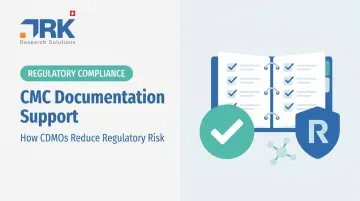
Too many teams still treat CMC as a late-stage paperwork exercise, something to clean up right before submission. That mindset is exactly what creates the gaps regulators flag. This article looks at how CDMOs operationally reduce that risk through CMC documentation support, not just what CMC theoretically covers on paper.
Key Takeaways
- CMC deficiencies remain the single largest category of FDA Refuse-to-File reasons on record.
- Integrated CDMOs catch data inconsistencies before submission, not after a Health Authority query arrives.
- Continuous documentation during tech transfer avoids costly reconstruction later.
- Harmonized Module 3 packages still require region-specific gap management for global filings.
- Treating CMC as an ongoing discipline avoids costly last-minute scrambles before filing.
What Is CMC Documentation Support?
CMC documentation support is the technical writing, data compilation, and regulatory formatting work that turns raw manufacturing and quality data into a submission-ready dossier, most visibly CTD Module 3.
It's not a single deliverable. It shows up across the entire product lifecycle:
- IND/CTA filings: establishing the initial quality baseline for first-in-human studies
- NDA/BLA/MAA submissions: compiling full drug substance and drug product evidence
- Technology transfers: documenting scale-up parameters and validation data
- Post-approval changes: updating specifications, stability data, and manufacturing controls
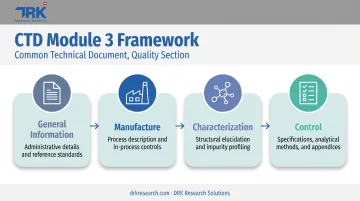
Regardless of which stage you're in, the CTD Module 3 structure stays consistent. ICH M4Q defines it, covering both drug substance (3.2.S) and drug product (3.2.P):
- General information: administrative details and reference standards
- Manufacture: process description and in-process controls
- Characterization: structural elucidation and impurity profiling
- Control: specifications and analytical methods, plus appendices and regional information
The guideline sets the format. It doesn't guarantee the underlying data is complete, consistent, or ready for review.
That's where documentation support earns its keep. Framed correctly, this work directly reduces the odds of a regulatory rejection, saving time and cost across the product lifecycle.
Key Advantages of How CDMOs Reduce Regulatory Risk Through CMC Documentation
The advantages below tie to metrics sponsors actually track: Health Authority (HA) query volume, submission timelines, first-cycle approval rates, and tech transfer success. Not abstract compliance benefits. These advantages also compound: a program that scales across phases and geographies gets more value from strong CMC practices with every added market or lifecycle change.
Fewer Regulatory Deficiencies and Clinical Holds
CDMOs apply structured authoring frameworks aligned to ICH M4Q that catch data inconsistencies before they reach a reviewer's desk. A mismatch between a manufacturing batch record and a stability claim, for instance, is exactly the kind of gap that triggers an HA information request if it slips through.
Dedicated regulatory writers and QC teams cross-check drug substance, drug product, and analytical data for completeness ahead of filing. This matters because incomplete or inconsistent CMC data is a documented driver of both clinical holds and Refuse-to-File decisions:
- CMC was the largest reason category across 103 FDA RTF letters studied, representing 125 of 644 total refusal reasons (JAMA Internal Medicine, 2021)
- Cell and gene therapy programs saw CMC concerns drive 21% of publicly announced clinical holds between 2020 and 2022
- Resolving CMC amendments in lifted holds took an average of 8.4 months, with amendments requested in a quarter of those cases (Molecular Therapy: Methods & Clinical Development, 2023)
Fewer inconsistencies mean fewer HA query cycles, and fewer query cycles mean a shorter path to approval. The KPIs affected here are concrete: number of information requests, resubmission cycles, clinical hold duration, and first-cycle approval rate.
This advantage matters most for complex products like combination devices, biologics, or multi-API formulations, and for any company currently facing a clinical hold with a tight resubmission deadline.
Faster Timelines Through Smoother Tech Transfer
When process development, manufacturing, and regulatory writing sit in separate silos, data gaps appear at exactly the moment a program needs speed: tech transfer. Integrated CDMOs coordinate these functions under one team, documenting scale-up parameters, validation protocols, and batch records in real time instead of reconstructing them after the fact.
DRK Research Solutions' product development team manages technology transfer this way, covering detailed process documentation and scale-up studies through to on-site support at manufacturing partners. This keeps formulations' quality and regulatory footing intact as production scales from lab to commercial volumes.

Why does this matter operationally? Because reconstruction is expensive. A 2018 Pharmaceutical Technology case study completed a fast-tracked soft-gelatin capsule transfer in nine months using predefined responsibilities, detailed process mapping, and weekly joint calls. Issues got resolved within a week instead of stalling the timeline. That's a single case, not an industry average, but it illustrates what disciplined, continuous documentation makes possible.
KPIs impacted include tech transfer cycle time, batch-to-batch consistency, process validation success rate, and time from clinical to commercial manufacturing.
This advantage matters most when scaling from clinical to commercial batches, or when transferring manufacturing between sites or regions.
Global Regulatory Harmonization Across Markets
CTD Modules 2 through 5 are designed to be common across ICH regions, letting sponsors avoid full reformatting for each authority. But Module 1 is regional, and M4Q's own 3.2.R section explicitly holds information that isn't common across all regions. In other words: a harmonized structure doesn't erase regional divergence.
CDMOs with multi-region regulatory expertise adapt one core CMC package to meet FDA, EMA, and other region-specific expectations without duplicating the underlying work. Localized knowledge (labeling nuances, translation needs, region-specific stability protocols) gets built into the documentation process from the start rather than bolted on later.
DRK's footprint across Europe, the Middle East, Asia, Africa, and the Americas lets sponsors align a single CMC package with regional expectations through one coordinated partner, rather than managing separate vendors per geography.
KPIs impacted: number of markets filed simultaneously, regional query rates, and time-to-global-launch.
This advantage matters most for companies pursuing multi-regional trials or targeting underserved and emerging markets alongside major regulatory agencies.
What Happens When CMC Documentation Support Is Missing or Ignored
Skip structured CMC support, and the consequences show up fast, often right when a program can least afford delay.
- Inconsistent data across modules triggers health authority (HA) information requests that could have been avoided
- Clinical holds or Refuse-to-File decisions become more likely, each adding months to a timeline
- Reactive, last-minute firefighting as teams scramble to reconcile documents before a deadline
- Rising costs from repeated resubmissions and extended review cycles
- Difficulty scaling documentation processes as pipelines or target markets expand
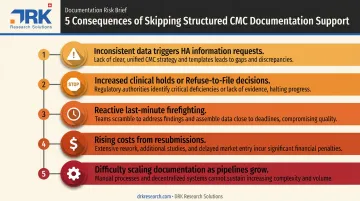
FDA's own procedures underscore how unforgiving this can be: an incomplete resubmission doesn't restart the review clock, it simply stalls. And the agency can withhold approvals tied to a manufacturer with unresolved compliance findings. Incomplete documentation directly determines approval timing.
How to Get the Most Value from CDMO CMC Documentation Support
CMC documentation support pays off most when it starts early, ideally during preclinical planning or early Phase I, rather than only once problems surface. Waiting until a submission deadline looms turns documentation into damage control.
Value compounds further when three practices hold across every development phase:
- Start early: Build documentation habits during preclinical planning, before problems surface
- Stay consistent: Apply the same standards and templates from Phase I through Phase III
- Review regularly: Check the dossier against evolving ICH and regional guidance at each phase gate
A dossier built with this discipline at Phase I is far easier to extend at Phase III than one patched together retroactively.
The practical recommendation: partner with a CDMO that integrates regulatory writing, analytical, and manufacturing expertise under one roof. DRK Research Solutions' combined CRO/CDMO model works this way — manufacturing and quality insights feed directly into submission-ready documentation instead of getting siloed and reworked later in the process.
Conclusion
CDMO-supported CMC documentation reduces regulatory risk by building control and consistency into every stage of the product lifecycle. Sponsors who apply this proactively see fewer deficiencies, faster tech transfer, and smoother global harmonization, and these gains compound over time.
Companies serious about de-risking their regulatory path should treat CMC documentation as an ongoing partnership. DRK Research Solutions embeds this discipline throughout development, from technology transfer to analytical method development and eCTD dossier preparation.
Frequently Asked Questions
What does CMC mean in regulatory affairs?
CMC stands for Chemistry, Manufacturing, and Controls. It is the body of technical evidence that demonstrates a product's quality, safety, and manufacturing consistency to regulators throughout development and beyond.
What documents are typically included in CMC submissions?
Key examples include CTD Module 3 quality data, Drug Master Files, batch manufacturing records, stability study reports, and analytical method validation packages.
How does a CDMO reduce regulatory risk in CMC documentation?
Integrated CDMOs combine regulatory writing, analytical, and manufacturing expertise so data inconsistencies get caught before submission, not after a Health Authority flags them.
What happens if CMC documentation is incomplete or inconsistent?
Incomplete or inconsistent data commonly triggers HA information requests, clinical holds, or Refuse-to-File decisions, each adding weeks or months to a program's timeline.
When should a company start CMC documentation planning with a CDMO?
Early engagement, ideally during preclinical work or early Phase I planning, avoids the rework and gaps that surface when documentation is addressed only near a filing deadline.
What is included in CTD Module 3 for CMC?
Module 3 covers drug substance and drug product data, manufacturing process details, specifications, analytical methods, appendices, and region-specific information.