Yet validation shows up constantly in SOPs and inspection checklists as a term everyone references but few fully unpack. Teams often treat it as a checkbox: run the protocol, file the report, move on. That mindset creates compliance gaps that surface at the worst possible time — during an audit.
This guide breaks down what equipment validation actually means, why cGMP frameworks require it, how the IQ/OQ/PQ process works in practice, and where it applies across a manufacturing operation.
Key Takeaways
- Validation provides documented evidence that equipment reliably meets specifications
- cGMP frameworks (21 CFR Part 211, EU Annex 15, ICH Q7) treat validation as an ongoing lifecycle
- The IQ/OQ/PQ sequence moves equipment from "unqualified" to a documented validated state
- Run counts and requalification scope should be risk-justified, not arbitrary
- Repairs, relocations, process changes, and periodic review all trigger revalidation
What Is Equipment Validation?
Equipment validation is documented evidence that equipment or systems consistently produce results within predefined specifications required by cGMP. In plain terms: it proves the equipment is fit for its intended use, which reduces the risk of defective product, recalls, and patient harm.
There's frequent confusion between three related but distinct terms:
- Equipment qualification — verifies a specific piece of equipment is properly installed, operates correctly, and produces expected results
- Equipment validation — the broader documented assurance that a system reliably delivers quality outcomes
- Process validation — covers the entire manufacturing process, not just individual equipment
Qualification is a subset of validation. You qualify a piece of equipment; you validate a process that depends on it.
Validation Is a Lifecycle, Not an Event
Validation doesn't end when a protocol is signed off. It runs through several stages:
- User Requirement Specification (URS) — defines what the equipment must do
- Design Qualification (DQ) — confirms the design meets the URS
- Installation Qualification (IQ) — verifies correct installation
- Operational Qualification (OQ) — verifies correct operation
- Performance Qualification (PQ) — verifies consistent performance under real conditions
- Periodic review — confirms the equipment stays in a validated state
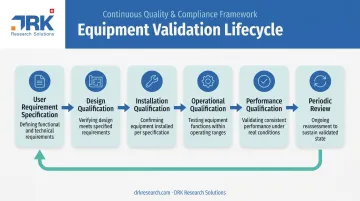
This lifecycle approach aligns with major regulatory frameworks:
- FDA 21 CFR Part 211 sets enforceable equipment-control duties
- EU GMP Annex 15 requires lifecycle control with periodic evaluation
- ICH Q7 defines qualification as confirming equipment is installed correctly and operates as intended
None of these frameworks treat validation as a single pass-fail moment.
Why Equipment Validation Matters in cGMP Manufacturing
cGMP fundamentally demands consistency, product quality, data integrity, and patient safety. Equipment validation addresses each of these directly: it's the mechanism that proves your equipment can be trusted to produce the same quality output, batch after batch.
Skip it, or do it poorly, and the consequences show up fast:
- Batch failures from equipment operating outside true limits
- Contamination from improperly qualified cleaning or sterilization systems
- Incorrect dosing from filling or dispensing equipment that wasn't tested at worst-case conditions
- Product recalls tied back to equipment that was never properly verified
- Inspection findings that halt production or delay approvals
Regulators treat equipment issues seriously. In one recent example, FDA's warning letter to Bio-Medical Pharmaceutical Manufacturing Corporation cited inadequate equipment qualification and demanded a comprehensive, independent assessment before manufacturing could continue. That finding directly delayed the company's production timelines.
Equipment validation is both a regulatory mandate across FDA, EMA, and WHO frameworks, and an operational best practice. It requires periodic requalification whenever equipment, processes, or regulations change.
Navigating validation across multiple regulatory regions adds real complexity. A protocol accepted in the US may need adjustment for EU Annex 15 expectations or WHO Prequalification requirements. This is where sponsors often lean on partners with multi-region regulatory experience.
DRK Research Solutions supports pharmaceutical and biopharmaceutical sponsors through its GxP & Regulatory Compliance Consulting vertical, covering EU GMP, MHRA, PIC/S, WHO PQ, and US FDA frameworks. The team helps sponsors align documentation and compliance strategy with global cGMP expectations, rather than treating each market as a separate exercise.
How Equipment Validation Works (Conceptual Flow)
Validation flows end-to-end, from defining what the equipment must do through confirming it actually does it, under real conditions, reliably.
The process draws on several inputs:
- User Requirement Specifications (URS) defining functional needs
- Design specifications showing how the equipment meets those needs
- Risk assessments identifying critical parameters
- Predefined acceptance criteria that determine pass or fail
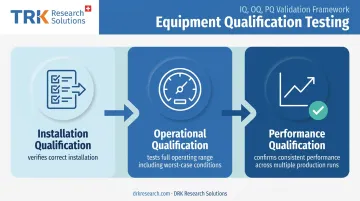
Testing happens at increasing levels of rigor. First, confirm the equipment was installed correctly. Then confirm it operates correctly. Finally, confirm it performs reliably under actual production conditions.
Each stage is controlled through approved protocols, documented acceptance criteria, deviation management, and change control, so nothing moves forward on a shrug and a signature.
The result: equipment shifts from an unqualified state to a documented validated state. That state isn't permanent. It has to be actively maintained through periodic review and revalidation when circumstances change.
Step 1: Installation Qualification (IQ)
IQ verifies the equipment is installed exactly per specification. This means checking:
- Utilities are properly connected
- All components listed in the design specification are present
- Documentation is complete
- Calibration status of critical instruments is confirmed
Nothing moves to operational testing until installation checks out cleanly.
Step 2: Operational Qualification (OQ)
OQ tests functionality across the equipment's full operating range, not just the "sweet spot" conditions, but boundary and worst-case scenarios too. Each test runs against predefined acceptance criteria. This is where you find out if the equipment can handle the edges of its intended range, not just the middle.
Step 3: Performance Qualification (PQ)
PQ demonstrates consistent performance under actual production conditions. It typically spans multiple consecutive runs, but the exact number should be risk-justified rather than a default figure. The often-cited "three batches" rule actually applies to process performance qualification under FDA's process validation guidance, not equipment PQ specifically. Equipment PQ run counts should reflect the equipment's intended use, operating variability, and criticality, not a borrowed number from a different validation category.
Where Equipment Validation Is Applied & Key Factors That Affect It
Equipment validation applies broadly across cGMP manufacturing, though not every asset needs the same depth of qualification. Systems that typically require it include:
- Tablet presses and filling lines
- Sterilizers and autoclaves
- HVAC systems
- WFI and clean steam systems
- Analytical and laboratory instruments
Knowing which systems need validation is only half the equation — validation also gets triggered at specific points in the equipment lifecycle:
- New equipment installation
- Post-maintenance or repair activity
- After modification or relocation
- Process or product changes affecting the equipment's role
- Scheduled periodic review
Factors That Shape Validation Outcomes
Several variables influence how validation plays out in practice:
- Input materials and batch variability: inconsistent raw materials can mask or mimic equipment performance issues
- Operating conditions: temperature, pressure, and humidity swings change how equipment performs in real use
- Equipment and utility dependencies: including calibration status of instruments feeding into the process
- Scale, throughput, and campaign frequency: a line running continuous campaigns needs different validation depth than one used occasionally
- Regulatory and quality constraints: specific to the product type and the markets it's headed for
Common Issues, Misconceptions, and When Validation May Not Be Appropriate
The biggest misconception: validation as a one-time checkbox. It isn't. It's a lifecycle that requires ongoing change control and periodic review, and treating it otherwise is how documentation gaps creep in.
Another frequent mix-up is confusing equipment qualification (equipment-focused) with equipment validation (process-focused). Teams sometimes complete IQ/OQ thoroughly but fail to connect that work to the broader process validation narrative, leaving a documentation gap an auditor will find.
Other patterns worth watching for:
- Loose acceptance criteria: Setting OQ/PQ limits wider than the process actually requires is a common inspection finding, since it suggests the equipment wasn't tested against real production needs
- Over-validation of low-risk equipment: Applying full DQ/IQ/OQ/PQ to equipment with minimal product-quality impact wastes resources without improving assurance
- Assuming full requalification after every change: Minor changes that don't affect fundamental design or installation may only need partial requalification, such as OQ/PQ only, based on a documented risk assessment
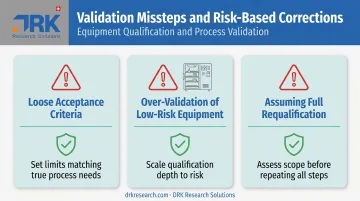
The signal that validation scope has drifted "by default" rather than by risk: your team can't explain why a given piece of equipment received the qualification depth it did. Risk-based scoping, not blanket application, protects both product quality and inspection readiness across cGMP-regulated markets.
Getting this balance right often calls for outside GxP expertise. DRK's regulatory compliance consulting and technology transfer support help sponsors build validation strategies that hold up across multi-region inspections.
Frequently Asked Questions
How do you perform equipment validation in pharma?
The sequence runs through URS, DQ, IQ, OQ, and PQ, with each stage backed by an approved protocol and a documented report. Teams define acceptance criteria upfront and formally manage deviations before advancing to the next stage.
Why are three batches required for validation in pharma?
Three consecutive batches represent a historical baseline for showing process consistency, but current FDA guidance requires the run count to be scientifically justified based on risk rather than defaulted to three. This applies to process PPQ, not equipment PQ.
What are the four types of equipment validation in pharma?
DQ verifies the design meets requirements, IQ verifies installation, OQ verifies operation across the full range including worst-case conditions, and PQ verifies consistent performance under real production use.
What are the WHO guidelines for equipment validation?
WHO Technical Report Series No. 1019, Annex 3 covers validation and qualification guidance, aligning closely with GMP principles used by FDA and EU frameworks. It expects a documented qualification lifecycle rather than a one-time exercise.
What is the difference between equipment validation and equipment qualification?
Qualification verifies that specific equipment is fit for its intended purpose. Validation is the broader, process-level demonstration that a system reliably produces quality outcomes using that equipment.
How often should equipment be revalidated in cGMP manufacturing?
Significant events — repairs, relocation, or modification — trigger revalidation, reinforced through periodic reviews at intervals justified by risk and equipment criticality rather than a fixed universal schedule.