Introduction
Open any medicine cabinet and you'll find the reality of pharmaceutical manufacturing: tablets, capsules, syrups, and creams line the shelves. Nearly all of them came from non-sterile production lines, not the aseptic suites most people picture when they think "pharma factory."
That confuses a lot of people. Non-sterile doesn't mean unregulated. Every batch still answers to strict cGMP requirements and defined microbial limits under 21 CFR 211.113.
The stakes are real too. FDA's own review of adverse-event data tied intrinsic microbial contamination to 32 serious adverse-event reports out of 197 total FAERS reports over a four-year period. Separately, more than 50 recall events involved contaminated non-sterile drugs.
This article breaks down what non-sterile manufacturing actually involves, how it differs from sterile production, and the step-by-step process behind it. It also covers where this method shows up across the industry and what to look for in a manufacturing partner.
Key Takeaways
- Non-sterile manufacturing covers oral solids, liquids, semi-solids, and suppositories under defined microbial limits, not full sterilization
- Core steps include raw material testing, compounding, processing, monitoring, packaging, and QC release
- USP
<60>,<61>, and<62>govern microbial testing for non-sterile products - An experienced CDMO partner reduces contamination risk and speeds regulatory timelines
What Is Non-Sterile Pharmaceutical Manufacturing?
Non-sterile pharmaceutical manufacturing produces drug products that aren't required to be completely free of microorganisms, but must stay within defined microbial limits. The governing regulation, 21 CFR 211.113(a), requires written procedures "designed to prevent objectionable microorganisms in drug products not required to be sterile."
This covers most of what patients actually take:
- Oral solids — tablets, capsules
- Oral liquids — solutions, suspensions, syrups
- Semi-solids — creams, ointments, gels
- Suppositories
What Counts as an "Objectionable" Microorganism?
FDA's 2021 draft guidance frames objectionable microorganisms as those that cause a detrimental product effect, threaten patient harm, or exceed acceptable totals. The determination isn't fixed. It shifts based on:
- Patient population (immunocompromised vs. general)
- Route of administration
- Product characteristics and manufacturing environment
The real distinction between sterile and non-sterile comes down to risk-appropriate control, scaled to how much harm contamination could actually cause a given patient.
The Regulatory Framework
Non-sterile manufacturers work within a layered system: cGMP under 21 CFR Part 211, USP compendial testing chapters, and WHO manufacturing guidance for facilities exporting to prequalified markets. Each framework calibrates its requirements to how the product reaches the patient, applying risk-appropriate oversight rather than a reduced one.
The consequences of getting it wrong are documented. FDA's review of FAERS data from 2014–2017 found 197 reports linked to intrinsic microbial or fungal contamination, including 32 serious adverse events, plus over 50 recall events tied to objectionable organisms in non-sterile drugs. Underreporting is likely, given the voluntary nature of adverse-event submissions.
Sterile vs Non-Sterile Manufacturing: Key Differences & Regulatory Standards
The core distinction comes down to one question: does the product need to be completely free of microorganisms, or just within an acceptable, monitored range?
Sterilization, Facility & Environmental Controls
Sterile production relies on validated sterilization methods, autoclaving, gamma or e-beam irradiation, ethylene oxide, to eliminate all viable organisms. Non-sterile production instead controls bioburden through:
- Validated cleaning and sanitation programs
- Component and water testing
- Environmental monitoring calibrated to product risk
There's no terminal kill step. The control happens throughout the process, not at the end.
This distinction extends to how facilities are classified. Sterile facilities operate under strict cleanroom classification. FDA's guidance identifies critical aseptic space as ISO 5, with at least ISO 7 immediately adjacent under dynamic conditions, and ISO 8 for less critical activities like equipment cleaning.
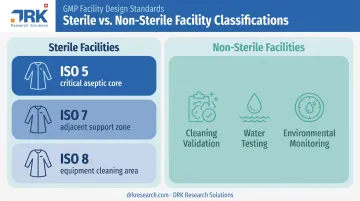
Non-sterile facilities don't follow one universal classification. WHO instead requires manufacturers to define their own controlled environment, with cleanliness levels set by product risk and process sensitivity. It's less rigid, but far from unmonitored.
Testing, Compendial Standards & Risk-Based Control
Here's where sterile and non-sterile products truly part ways:
| Product Type | Testing Standard | Purpose |
|---|---|---|
| Injectables, ophthalmics (sterile) | USP <71>, USP <85> | Sterility testing, bacterial endotoxin limits |
| Tablets, creams, oral liquids (non-sterile) | USP <61>, USP <62>, USP <60> | Microbial enumeration, specified organisms, BCC testing |
USP <61> quantifies total aerobic bacteria and fungi. USP <62> checks for the absence (or limited presence) of specified organisms. USP <60> addresses Burkholderia cepacia complex risk, particularly relevant for aqueous oral and topical products.
These compendial limits don't apply uniformly across every product, though. Route of administration and patient population drive the acceptance criteria, found in USP <1111> and product-specific monographs.
A topical cream for general use faces different limits than an oral suspension marketed for pediatric or immunocompromised patients. This is risk assessment in practice, not a compliance shortcut.
The Non-Sterile Manufacturing Process: Step-by-Step
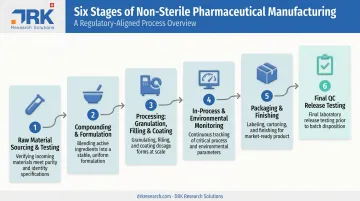
Production moves through six connected stages, each building on quality controls from the last.
Raw material sourcing & testing. APIs and excipients undergo identity, potency, and microbial bioburden testing before release. Purified water gets its own action limits, often under 100 CFU/mL for solid oral forms, though liquid and topical products may need tighter thresholds.
Compounding & formulation. Actives blend with excipients to achieve homogeneity. Solid formulation relies on mixing and granulation studies; liquid and semi-solid compounding depends more on homogenization and viscosity control.
Processing: granulation, filling & coating. Solid dosage forms move through granulation, drying, and compression or encapsulation. Liquids and semi-solids follow a different path: homogenization followed by filling, sometimes with continued bulk mixing to maintain suspension uniformity.
In-process & environmental monitoring. Ongoing checks track tablet weight, hardness, moisture, disintegration, pH, and viscosity, alongside environmental monitoring for water, equipment, personnel, and surfaces. This keeps the facility in what regulators call a documented state of control.
Packaging & finishing. Blister packs, bottles, and tubes get selected based on stability needs and contamination risk after manufacture, not just cost or convenience.
Final QC release testing. Every batch faces testing against USP <61>/<62> limits, covering total aerobic count, yeast and mold count, and specified-organism screening. Only then does it clear for release. FDA is explicit here: finished-product testing and preservatives can't substitute for solid process controls upstream.
Common Non-Sterile Dosage Forms & Industry Use Cases
Non-sterile dosage forms show up across nearly every therapeutic category, each solving a different clinical or practical problem.
- Oral solids (tablets, capsules) — the backbone of chronic disease management, from hypertension to diabetes, where dosing consistency and shelf stability matter most
- Oral liquids (solutions, suspensions, syrups) — critical for pediatric and geriatric patients who struggle to swallow tablets
- Semi-solids (creams, ointments, gels) — the standard for dermatology treatments and localized therapy
- Suppositories — used where oral administration isn't practical, including certain pediatric and palliative care settings
Dosage form choice also determines who can access treatment.
Generics, Hybrids & Market Access
Generic and hybrid non-sterile products play a direct role in expanding access to affordable chronic-disease treatment, particularly in emerging markets. WHO reported that one in five countries faced stockouts of noncommunicable disease medicines in 2021, with shortages hitting up to 41% of low-income countries versus just 4% of high-income countries.
Quality-assured generics are one of the few levers that close that gap without waiting on new drug development.
Retail markets pull non-sterile formulations in another direction too.
The OTC & Consumer Health Growth Curve
Consumer demand for non-prescription liquids and topicals keeps climbing. The broader topical drugs market was valued at $190.5 billion in 2024, with projections reaching $269.3 billion by 2030, a 6.0% compound annual growth rate. That growth reflects self-care trends and expanding retail access to non-sterile formulations worldwide.
Choosing the Right CDMO Partner for Non-Sterile Manufacturing
Building and validating a non-sterile facility from scratch is expensive and slow. That's why sponsors, especially those developing generics and hybrid products, increasingly outsource to CDMOs with the facilities, regulatory expertise, and dosage-form know-how already in place.
What to look for in a partner:
- Proven cGMP compliance history across multiple regulatory frameworks
- Multi-region regulatory experience (EU GMP, US FDA, MHRA, WHO PQ, PIC/S)
- Dosage-form-specific expertise matching your product type
- Demonstrated track record in accelerated, cost-efficient development
DRK Research Solutions supports sponsors across this process through its formulation development, analytical method development, and technology transfer services for generic and hybrid non-sterile products, including tablets, capsules, oral liquids, suspensions, and semi-solids. Its network spans Europe, the Middle East, Asia, Africa, and the Americas, with a specific focus on accelerating access in underserved regions where chronic-disease medicines are hardest to source.
What sets an integrated model apart is continuity. DRK's combined CRO and product development capabilities mean a sponsor can move from Phase II–IV clinical development straight into formulation work and technology transfer planning, without switching partners or re-qualifying data mid-project.

That continuity reduces the delays and compliance gaps that typically appear when clinical teams and development teams sit in different organizations. Sponsors evaluating this path can reach DRK's team directly to discuss dosage-form-specific requirements.
Frequently Asked Questions
What is non-sterile manufacturing?
Non-sterile manufacturing produces drug products that do not require terminal sterilization but must still meet defined microbial limits under cGMP. It relies on bioburden control rather than eliminating all microorganisms.
What is the difference between sterile and non-sterile?
Sterile production uses validated sterilization methods and strict cleanroom classifications tied to route-of-administration risk. Non-sterile production controls bioburden through USP <61>/<62> testing rather than USP <71>/<85> sterility and endotoxin standards.
What are examples of non-sterile pharmaceutical products?
Common examples include tablets, capsules, oral liquids like syrups and suspensions, creams, ointments, and suppositories. These make up the majority of medicines patients take daily.
What are the main regulatory standards for non-sterile pharmaceutical products?
Key standards include USP <60>, <61>, and <62> for microbial testing, 21 CFR 211.113 for contamination control, and FDA guidance on objectionable microorganisms.
How does a non-sterile manufacturing facility differ from a sterile one?
Sterile facilities require classified cleanrooms (ISO 5–8) with aseptic gowning. Non-sterile facilities use manufacturer-defined controlled environments, with monitoring intensity scaled to product and process risk.
Why do pharma companies outsource non-sterile manufacturing to a CDMO?
Outsourcing avoids the cost and time of building validated facilities while providing access to established regulatory expertise. This speeds up time-to-market, especially for generics and hybrid products entering multiple regions.