
3D printing is changing that equation. Instead of compressing pre-mixed powders, formulation scientists now build tablets layer by layer from a digital design file, adjusting dose, shape, and release rate the way an engineer would adjust a CAD drawing.
The turning point came in 2015, when the FDA approved Spritam (levetiracetam), the first drug ever manufactured using 3D printing, proving the technology could produce a real, marketed medicine rather than a lab novelty as documented in Aprecia's approval announcement.
This article covers how pharmaceutical 3D printing works, the leading techniques in use today, its practical benefits, the approved and pipeline drugs built on it, and where regulation is heading next.
Key Takeaways
- 3D printing builds drugs from digital files, enabling precise, patient-specific dosing
- Spritam remains the only FDA-approved 3D printed drug; Triastek holds multiple IND clearances
- FDM, SSE, binder jetting, and vat photopolymerization serve distinct formulation needs
- The UK's 2025 point-of-care law is the first dedicated framework for this manufacturing model
- An experienced CDMO partner helps sponsors navigate this technology's regulatory complexity
What Is 3D Printing in Drug Product Development?
Pharmaceutical 3D printing, also called additive manufacturing, constructs tablets and other dosage forms directly from a digital design file, building them layer by layer rather than compressing or molding pre-mixed powder blends. The design lives in software before it ever becomes a physical product.
Conventional tableting, by contrast, is built around fixed-dose batches. A manufacturer sets up a production line to make millions of identical 500 mg tablets, and that's essentially all it can do without retooling. Additive manufacturing flips this:
- Dose can be adjusted per patient or per small batch without new tooling
- Shape and size can change to improve swallowability or drug release
- Release profile can be engineered into the internal structure of the tablet itself
This flexibility is central to the industry's shift toward personalized medicine, particularly for pediatric, geriatric, and rare-disease populations who often need non-standard doses that conventional manufacturing can't economically produce.
How the Technology Is Classified
ISO/ASTM 52900:2021 groups all additive manufacturing into seven broad categories. Pharmaceutical applications draw mainly from three: binder jetting, material extrusion, and vat photopolymerization, chosen depending on the drug's heat sensitivity and desired release behavior.
This approach has already enabled dosage forms that conventional compression simply cannot produce:
- A five-in-one polypill, extrusion-printed to combine immediate-release aspirin and hydrochlorothiazide with sustained-release pravastatin, atenolol, and ramipril compartments in a single tablet
- FDM mini-tablets with griseofulvin doses stepping from 0.19 mg to 3.91 mg in 0.19 mg increments
- Inkjet-printed dosage units carrying edible QR-code identification for traceability
Types of 3D Printing Technologies Used in Pharmaceuticals
Formulation scientists don't pick a printing method at random. The choice depends on the API's heat sensitivity, the release profile required, and how much product needs to be made.
Fused Deposition Modeling (FDM)
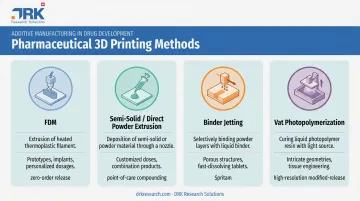
FDM melts a polymer filament and extrudes it through a heated nozzle, building tablets or implants one thin layer at a time. It's well suited to zero-order (constant-rate) release tablets, but heat sensitivity is a real constraint for many APIs.
Researchers have demonstrated that even thermolabile drugs can be processed this way. Ramipril, which has a melting point of just 109°C, was successfully printed using Kollidon VA64/12PF at a 70°C extrusion temperature and 90°C printing temperature, with no detectable degradation.
Semi-Solid Extrusion (SSE) and Direct Powder Extrusion (DPE)
SSE pushes semi-solid pastes through a syringe-style nozzle rather than melting a solid filament, avoiding high processing temperatures entirely. That makes it a strong fit for hospital point-of-care compounding, where pharmacists need to produce small, patient-specific batches on demand.
FabRx's M3DIMAKER 1 is a commercially available single-printhead platform offering both SSE and DPE, and it's been used in clinical feasibility studies with pediatric patients.
Binder Jetting (ZipDose Technology)
Binder jetting selectively deposits liquid binder into layers of powder, building a porous, high-drug-load structure that disintegrates almost instantly with a sip of liquid. This is the technology behind Spritam, still the only FDA-approved 3D printed drug, and it supports strengths up to 1,000 mg per tablet.
Vat Photopolymerization and Emerging High-Throughput Methods
SLA and DLP printing cure liquid resin with light, layer by layer, producing very high-resolution structures suited to complex modified-release designs. A 2023 DLP study of ibuprofen tablets reported roughly 80% in-vivo absorption within three hours for pulverized printed samples in preclinical testing.
Two newer methods are aimed squarely at scaling personalized production toward commercial volumes:
- Triastek's MED platform converts powder into a softened feed within a 25–250°C window, targeting up to 75 million tablets per year in initial production
- Laxxon's SPID screen-prints API/excipient inks into layered structures, claiming capacity up to 1.5 million dosage units daily
Both figures are vendor-reported design capacities rather than independently audited production data, but they signal where the industry is heading.
Benefits of 3D Printing for Drug Development
The appeal of additive manufacturing goes beyond novelty. It solves specific, documented problems in conventional drug development.
Precise, programmable dosing removes the guesswork from manually splitting tablets, a common practice for pediatric and geriatric patients that introduces real dosing variability. A printer can produce an exact fractional dose without a caregiver cutting a tablet in half.
Structural control over the dosage form can also improve solubility and bioavailability. A 2021 pharmacokinetic study comparing 3D-printed instant-dissolving levetiracetam tablets against Spritam in beagles found exposure ratios within the standard 80–125% bioequivalence range, suggesting engineered porosity can match a commercially validated release profile.
Formulation iteration moves faster too. FabRx's M3DISEEN platform, developed with University College London and the University of A Coruña, applies machine learning trained on hundreds of formulations collected over six years. It predicts printing parameters from a given API and excipient combination, compressing what used to be trial-and-error bench work.
Additional advantages include:
- Polypill combinations that merge multiple medications into one dosage form, easing adherence burdens for complex, multi-medication patients
- Unusual shapes and sizes designed specifically to improve swallowability in children
- Lower setup costs for small batches, since there's no need to build a dedicated high-volume tableting line for rare-disease populations
A peer-reviewed cost model for 3D-printed hydrocortisone tablets estimated total manufacturing costs of €1.97 to €3.11 per tablet, dropping to €1.58–€2.26 at scale. The study didn't measure this against a conventional tableting comparator, so it shouldn't be read as a universal cost-reduction figure. It does, however, establish that small-batch personalized production is economically viable at a per-unit level.
FDA-Approved 3D Printed Drugs and Clinical Pipeline
Spritam remains the anchor point of this entire field. Approved on July 31, 2015, it uses Aprecia's ZipDose binder-jetting process to create a porous tablet that disintegrates rapidly with a small sip of liquid. This matters for epilepsy patients who struggle to swallow conventional tablets.
The tablet is available in 250, 500, 750, and 1,000 mg strengths. A 2025 peer-reviewed review confirms it remains the only FDA-approved 3D printed medicine on the market a decade later.
Behind that single approval, however, a real pipeline is building. Triastek's T-series products, built on the company's MED technology, have collected several IND clearances:
| Product | IND Clearance | Condition | Dosing Advantage |
|---|---|---|---|
| T19 | Feb. 2021 | Rheumatoid arthritis | Bedtime chronotherapy, early-morning peak release |
| T20 | Mar. 2022 | Cardiovascular/clotting | Once-daily rather than twice-daily |
| T21 | Nov. 2022 | Ulcerative colitis (tofacitinib) | Imaging-confirmed colon-targeted release |
| T22 | Jan. 2024 | Pulmonary hypertension | Gastric-retention dosage form |
| T20G | Feb. 2025 | Atrial fibrillation (NOAC) | Gastric retention, sustained once-daily release |
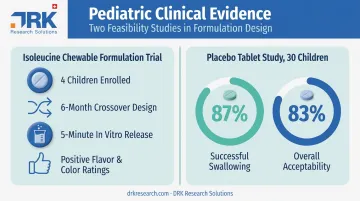
Beyond the Triastek pipeline, clinical evidence is expanding in hospital settings. Two recent pediatric studies illustrate this shift:
- A six-month crossover study gave four children with maple syrup urine disease personalized SSE-printed chewable isoleucine formulations, releasing the active ingredient within five minutes in vitro and scoring well for flavor and color.
- A separate feasibility study of 30 children found 87% successfully swallowed 3D-printed placebo tablets, with 83% overall acceptability.
These are feasibility studies, not therapeutic approvals, but they show the clinical evidence base extending well past Spritam.
Regulatory Landscape, Challenges, and the Road Ahead
Regulators are engaging with this technology, though frameworks are still catching up to the science. The FDA's Emerging Technology Program, established in 2014, gives sponsors an early channel to discuss novel manufacturing technologies before a formal submission, but it isn't itself an approval pathway. A January 2025 draft guidance addresses batch uniformity under 21 CFR 211.110, including advanced manufacturing considerations, but it stops short of a dedicated point-of-care rule.
The UK has moved further. The Human Medicines (Amendment) (Modular Manufacture and Point of Care) Regulations 2025 took effect on July 23, 2025, establishing the first dedicated legal framework globally for medicines produced outside conventional centralized facilities. The MHRA administers it through a licensed Control Site model with a Point of Care Master File governing dispersed manufacturing sites.
Still, several challenges remain:
- Heat-sensitive APIs limit which drugs can go through conventional FDM without degradation
- Scale-up is still slower than high-speed compression for mass-market volumes, and vendor capacity claims for newer platforms haven't been independently validated
- Quality control for personalized batches is genuinely hard, since variable geometry and dose complicate content uniformity testing and batch definition
- Standardization across printers, feedstocks, and process parameters doesn't yet exist as a harmonized GMP standard
Partnering with a CDMO for Innovative Drug Product Development
Sponsors exploring novel dosage form technologies, whether additive manufacturing or other complex formulation approaches, face a common problem: the science moves faster than the regulatory playbook. This is where an experienced CDMO partner earns its keep.
DRK Research Solutions supports sponsors through lab-scale formulation development, analytical method validation, and technology transfer for complex generics and hybrid products across regulated markets. That work includes preparing eCTD dossiers (Modules 2–5) and navigating EU GMP, US FDA, MHRA, PIC/S, and WHO PQ frameworks. This is the same regulatory infrastructure that any first-in-class manufacturing approach will eventually need to satisfy.
DRK's CDMO model manages technology transfer and regulatory strategy while working through a network of EU- and US-approved GMP manufacturing partners, rather than operating in-house production lines directly. For sponsors evaluating emerging manufacturing approaches, that combination of formulation expertise and multi-jurisdictional regulatory reach can help de-risk early adoption decisions before committing to a specific technology path.

Frequently Asked Questions
How is 3D printing used in drug product development?
CAD files guide layer-by-layer construction of tablets or dosage forms, enabling personalized dosing, novel shapes, and engineered release profiles that conventional tableting cannot achieve. It shifts manufacturing from fixed batches to digitally customizable production.
Which drugs are FDA-approved for 3D printing?
Spritam (levetiracetam) remains the only FDA-approved 3D printed drug, approved in 2015. Several other products, including Triastek's T-series, have IND clearance and are progressing through clinical trials.
What are the main types of 3D printing technology used in pharma?
The primary categories are fused deposition modeling, semi-solid/direct powder extrusion, binder jetting, and vat photopolymerization. Each suits different drug stability and release-profile requirements.
What are the benefits of 3D printing over traditional drug manufacturing?
Benefits include precise personalized dosing, potential bioavailability improvements through structural control, faster formulation iteration using AI-assisted tools, and cost efficiency for small-batch or rare-disease production.
Is 3D printing of medicines safe and regulated?
Regulatory bodies including the FDA and UK's MHRA have established emerging frameworks and quality-control expectations for this technology. Standardization across printers and processes is still evolving.
What is the future outlook for 3D printed drugs?
Expanding clinical trials and new high-throughput printing technologies are building momentum. Supportive regulation, such as the UK's 2025 framework, points toward wider adoption of personalized and point-of-care medicine production in the coming years.