This explanation is written for pharma and biopharma sponsors, emerging and virtual pharma teams, and CMC professionals who need clarity on what actually happens between "we found a promising molecule" and "we can manufacture it consistently." The stakes are high: get chemical development wrong, and you risk failed batches, regulatory delays, or a process that simply doesn't scale.
Part of the confusion comes from language. Terms like "chemical development," "process chemistry," "R&D," and "F&D" get used interchangeably, even though they describe different activities. This article untangles those terms, walks through how the process actually works, and explains when outsourcing it to a specialized partner makes sense.
Key Takeaways
- Chemical development turns an early synthetic route into a robust, GMP-ready manufacturing process for an API
- It differs from R&D (candidate discovery) and F&D (dosage form design), though all three connect closely
- Core stages include route scouting, process optimization/scale-up, and technology transfer/validation
- Success depends on starting material quality, equipment access, scale, and regulatory constraints such as ICH Q11
- Emerging pharma companies increasingly rely on CDMO partners instead of building this capability in-house
What Is Chemical Development in the Pharmaceutical Process?
Chemical development transforms an early, often inefficient laboratory synthesis into a process that's safe, reproducible, and scalable enough for commercial manufacturing. A medicinal chemist's original route might work beautifully on a lab bench with 500 milligrams of material. It often falls apart entirely at a 50-kilogram scale.
The goal is straightforward: produce a manufacturing process for the drug substance that's cost-effective, consistent batch after batch, and ready to withstand regulatory scrutiny.
R&D, F&D, and Chemical Development Aren't the Same Thing
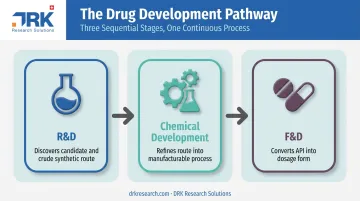
These three terms describe different stages of the same overall journey:
- R&D generates the drug candidate itself and the initial, often crude, synthetic route used to make the first few grams
- Chemical development sits between discovery and formulation, refining that synthetic route into something manufacturable
- F&D (Formulation & Development) takes the finished API and figures out how to turn it into a tablet, capsule, or injectable — the dosage form patients actually receive
Chemical development is frequently called "process chemistry" by practitioners, and the terms are largely interchangeable in day-to-day use. Chemical development is also distinct from preformulation, a downstream activity that studies the physicochemical properties of the API to inform dosage form design. Preformulation depends on chemical development being finished, or nearly so. It doesn't refine the synthesis itself.
Why Chemical Development Is Critical in the Pharmaceutical Industry
Modern drug candidates aren't getting easier to work with. A 2023 peer-reviewed review estimates that 70-90% of development-stage drug candidates are poorly soluble, compared to roughly 40% of already-marketed products (Kumari et al., 2023). That's a meaningful shift in the kind of molecules chemists are being asked to manufacture at scale.
The industry expects chemical development to deliver on several fronts at once:
- Consistency between batches, so patients get the same drug every time
- Purity that meets impurity thresholds, including genotoxic impurity limits
- Yield and cost-efficiency, since raw material and processing costs compound at scale
- Regulatory-grade documentation that supports IND, NDA, or ANDA filings
Skip proper chemical development, and the consequences show up fast. Teams see inconsistent API batches, failed scale-up runs, unexpected impurities, and IND or NDA filings pushed back by months.
The Regulatory Angle
Regulators hold chemical development to a firm standard here. ICH Q11 requires sponsors to define an appropriate manufacturing process, identify critical quality attributes, and build a control strategy that assures drug-substance quality throughout the commercial lifecycle. Small-scale models used during development have to represent the eventual commercial process, accounting for scale effects rather than assuming a simple linear scale-up.
Compressed development timelines add pressure here. When teams rush from candidate nomination toward an IND filing, there's a real risk of making process decisions before enough data exists to support them — a dynamic that shows up in rushed analytical method development and processes that later prove unscalable.
This is why many emerging and virtual pharma companies partner with product-development specialists like DRK Research Solutions instead of building every capability in-house. Access to formulation science, analytical method development, and regulatory dossier expertise, without the capital investment of dedicated infrastructure, changes the economics for smaller sponsors considerably.
How the Chemical Development Process Works
At a high level, chemical development moves from an initial route assessment to a validated, scalable manufacturing process. What goes in: the discovery-stage synthetic route, available starting materials and reagents, and whatever analytical data exists on the molecule so far.
What happens during the core work:
- Evaluate each reaction step for feasibility and safety
- Screen alternative routes against the original
- Optimize conditions for yield, purity, and process safety
Control comes from analytical characterization and structured experimentation:
- HPLC for assay and impurity quantitation
- XRPD, DSC, and TGA for polymorph and thermal behavior
- Design of experiments (DoE) and quality risk assessments mapping how process parameters interact
The output: a documented, validated process capable of consistent, GMP-compliant API production at whatever scale the program needs.
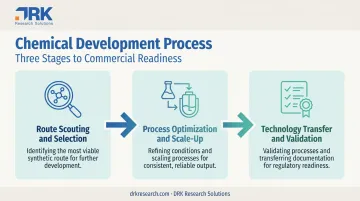
Step 1: Route Scouting and Selection
Chemists evaluate multiple synthetic pathways side by side, weighing feasibility, cost, safety, and scalability. The goal is the route with the fewest steps and highest overall yield that can still be executed safely at scale, not the most elegant chemistry. Starting-material availability and intellectual property considerations factor in here too.
Step 2: Process Optimization and Scale-Up
Chemists refine and test reaction conditions, solvent choices, and purification methods at increasing scale. A process that performs well in a 1-liter flask needs re-testing in a 50-liter reactor, then again in commercial-scale equipment. Robustness at each stage matters more than performance at any single scale.
Step 3: Technology Transfer and Validation
Once optimized, the team fully documents the process and hands it off to a GMP manufacturing site. There, it undergoes validation to confirm it can produce consistent, regulator-compliant API, following the FDA's three-stage model of Process Design, Process Qualification, and Continued Process Verification.
Where Chemical Development Is Applied and What Affects It
Where the Process Happens
Chemical development typically occurs in API pilot plants, kilo labs, and CDMO manufacturing facilities. It shows up at several distinct points in the drug lifecycle:
- Immediately after candidate nomination, refining the initial R&D route
- Pre-IND, to generate enough material and data for early clinical supply
- Again ahead of commercial launch, during formal process validation
Chemical development isn't a one-time event. It gets triggered repeatedly — by scale-up needs, cost-reduction goals, newly discovered impurities, or regulatory feedback requesting more data.
Key Factors That Affect Chemical Development
Several variables shape how smoothly this process goes:
- Inputs and materials — starting material quality, reagent purity, and solvent selection all directly affect yield and impurity profiles
- Operating conditions — shifts in temperature, pressure, or reaction time can change selectivity and intermediate stability
- Equipment dependencies — specialized reactors, chromatography systems, or crystallization equipment aren't always available at every scale
- Scale and throughput — lab-scale success is not a guarantee of pilot- or commercial-scale reproducibility
- Safety and regulatory constraints — ICH mutagenic impurity limits, waste-handling rules, and green chemistry expectations differ widely by target market
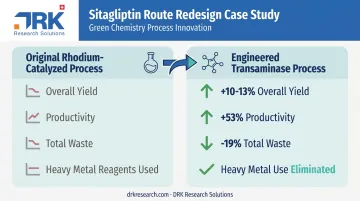
A well-documented example of route redesign paying off: researchers replaced a rhodium-catalyzed hydrogenation step in sitagliptin manufacturing with an engineered transaminase enzyme. The switch increased overall yield by 10-13%, boosted productivity by 53%, cut total waste by 19%, and eliminated heavy metal use entirely (Savile et al., 2010). The case shows how redesigning a single step can reshape both a process's economics and its environmental footprint.
Navigating these constraints gets more complicated when a product targets multiple regulated markets simultaneously. DRK Research Solutions supports sponsors developing generics and hybrid products by coordinating regulatory strategy across EU GMP, US FDA, WHO PQ, and PIC/S requirements, then connecting them to GMP-qualified manufacturing partners suited to each target market.
Common Issues, Misconceptions, and When It May Not Be Appropriate
Common Issues and Misconceptions
The most persistent mistake: assuming a lab-scale synthetic route can simply be "multiplied up" for commercial production without re-optimization. Reaction behavior, heat transfer, and mixing dynamics all change at scale in ways that bench chemistry can't predict.
A second misconception treats chemical development as a one-time task, checked off after the first route is validated. In reality, it's revisited at nearly every development phase, as new data, impurity findings, or regulatory feedback emerge.
The activity and its outcome are two different things. Chemical development is the ongoing process of refining synthesis; the validated manufacturing process or CMC package is what that process produces. Confusing the two leads teams to think the work is finished once documentation exists, when the underlying process may still need further refinement.
When Chemical Development May Not Be Appropriate
Full-scale chemical development isn't always the right investment:
- Early discovery-stage screening batches not intended for clinical use rarely justify the cost of route optimization
- Tight budgets or timelines before candidate viability is confirmed can make extensive optimization premature
- Stereochemically complex molecules may suit biosynthesis or fermentation routes better, since microorganisms reach heterocycles synthetic chemistry can't, though adoption stays limited by cost
Conclusion
Chemical development takes an early, often fragile synthetic route and turns it into a safe, scalable, regulator-ready process for manufacturing API. Pharma and biopharma sponsors juggle quality expectations, timelines, and regulatory risk daily. Understanding how this process actually works — not just what it produces — makes the difference between a smooth path to filing and a costly, delayed one.
Achieving that smooth path starts with phase-appropriate application, not default assumptions about how much optimization a molecule needs at any given stage. Partnering with an experienced global CRO/CDMO like DRK Research Solutions can help sponsors integrate chemical development smoothly with clinical and regulatory strategy, particularly when in-house infrastructure isn't yet in place.
Frequently Asked Questions
What is chemical process development in the pharmaceutical industry?
It's the discipline of designing and optimizing a scalable, reproducible synthetic route for manufacturing an API. The process starts at early discovery and gets refined step-by-step through to commercial readiness.
What is the difference between R&D and F&D?
R&D (Research & Development) focuses on discovering and validating the drug candidate and its initial synthesis. F&D (Formulation & Development) takes that API and converts it into a stable, deliverable dosage form like a tablet or injectable.
What is the difference between chemical development and process chemistry?
The terms are often used interchangeably. Where they differ, "process chemistry" typically refers more narrowly to bench-level reaction optimization within the broader chemical development effort.
Who performs chemical development in a pharmaceutical company?
Process chemists and chemical engineers usually lead this work, supported by analytical scientists. For outsourced programs, CDMO partners often take on this role for sponsors without in-house capability.
How long does chemical development take before commercial manufacturing?
It spans from early candidate nomination through commercial launch, often stretching across multiple years, with intensity increasing as a molecule advances through clinical phases.
What role does a CDMO play in chemical development?
CDMOs provide specialized expertise, equipment access, and regulatory experience to optimize and scale a sponsor's chemical process. This is especially valuable for emerging and virtual pharma companies without in-house manufacturing capability.