Many sponsors run into the same wall. Finding a contract development and manufacturing organization with the cleanroom infrastructure, the multi-region regulatory track record, and the formulation science to pull off sterile production without blowing the timeline isn't easy. The stakes are high, and the list of CDMOs that check every box is short.
This article breaks down what actually separates a capable sterile CDMO from one that merely claims it can do the work, and what to look for when choosing a partner for your next injectable, biologic, or ophthalmic program.
Key Takeaways
- Sterile products bypass the body's defenses, making contamination control the core regulatory requirement
- A capable CDMO unites cleanroom infrastructure, multi-region compliance, and sterilization science into one system
- Choosing aseptic processing versus terminal sterilization early shapes the rest of development
- Evaluate partners on regulatory footprint, technical depth, and integrated CRO-CDMO capability to reduce timeline risk
Understanding Sterile Dosage Forms and Why Their Development Is Complex
Sterile dosage forms, also called parenteral preparations, are drugs administered by injection, infusion, or implantation, along with related routes such as ophthalmic, otic, and inhaled products where sterility is a filing requirement. FDA's route-of-administration taxonomy includes several delivery methods that demand sterility:
- Intravenous (IV) infusion directly into the bloodstream
- Intramuscular (IM) injection into muscle tissue
- Subcutaneous (SC) injection beneath the skin
- Intravitreal injection directly into the eye
What separates these routes from an oral tablet or a topical cream is simple: the body has no microbiome defense at the point of entry. A vein doesn't filter bacteria the way the gut does. An intravitreal injection sits inside the eye, where trace contamination can cause irreversible vision loss.
Oral and topical products tolerate a defined, controlled bioburden. Sterile products tolerate none. That distinction drives everything from cleanroom design to batch release testing. It's why FDA treats the aseptic critical area (where sterilized product and containers are exposed) as requiring ISO 5/Class 100 conditions throughout the operation.
Meeting that ISO 5 standard consistently is exactly why demand for outsourced sterile manufacturing keeps climbing. The sterile-injectables CDMO market was valued at $37.8 billion in 2025 and is projected to climb to $87.3 billion by 2033, an 11.2% compound annual growth rate, according to Grand View Research.
Biologics, high-concentration monoclonal antibodies, and increasingly complex fill-finish requirements are pushing sponsors toward outsourcing partners that in-house teams simply aren't equipped to replace.
That growth explains why only a subset of CDMOs have the full combination of facilities, sterilization expertise, and compliance history sterile programs demand. Here's what that combination actually looks like.
Core Requirement #1: Facility Infrastructure and Environmental Controls
Cleanroom Classification and Environmental Monitoring
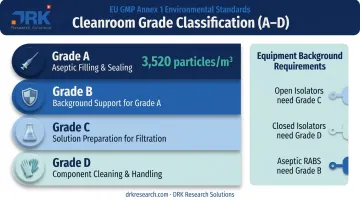
Sterile facilities run on a graded cleanroom system, borrowed from ISO 14644-1 and codified in EU GMP Annex 1. Each grade corresponds to specific activities:
| Grade | Typical activity |
|---|---|
| A | Aseptic filling, sealing, open-vial transfer, lyophilizer loading |
| B | Background support for Grade A operations outside an isolator |
| C | Preparing solutions destined for filtration |
| D | Component cleaning and handling |
A Grade A zone must hold particle counts at 3,520 particles per cubic meter (≥0.5 μm), whether at rest or during operation. There's no relaxation once filling starts.
Environmental monitoring doesn't stop at particle counts. CDMOs run continuous programs covering viable and non-viable contamination, with Grade A/B zones monitored throughout aseptic setup and critical processing.
Personnel add another layer of risk. Anyone working in Grade A/B space must complete:
- Initial gowning qualification before entering unsupervised
- Annual gowning reassessment to maintain clearance
- Successful participation in aseptic process simulations
Equipment and Aseptic Filling Technology
Equipment choices matter as much as room classification. Isolators and restricted access barrier systems (RABS) now dominate modern fill-finish lines. Annex 1 sets minimum background requirements accordingly:
- Open isolators require at least a Grade C background
- Closed isolators require at least Grade D
- Aseptic RABS require at least Grade B
Fill-finish lines also need to handle difficult formulations. High-concentration biologics can push peristaltic pumps toward their viscosity limits, while intravitreal products may require fill volumes as small as 0.15 to 0.25 mL. A CDMO's equipment has to hit that accuracy without shearing the protein or losing product to hold-up volume.
For products suited to terminal sterilization rather than aseptic fill, validated autoclaves, gamma or e-beam irradiation units, and ethylene oxide chambers all need product-specific cycle validation. A device-scoped ISO standard alone doesn't satisfy FDA; the method has to be justified for that specific formulation.
Visual inspection closes the loop. FDA's 2021 guidance calls for qualified, essentially complete inspection of each injectable unit for visible particles, backed by acceptance-quality-limit sampling at the batch level. Gaps at this checkpoint show up as recalls later.
Core Requirement #2: Regulatory Compliance and Sterility Assurance Systems
The Contamination Control Strategy Standard
A sterile CDMO can't comply with just one regulator. Sponsors selling into multiple markets need a partner fluent in FDA cGMP, EU GMP, and whatever regional framework applies at the destination, whether that's UK MHRA, WHO PQ, or a local ministry of health.
The 2022 revision to EU GMP Annex 1 raised the bar. It requires a facility-wide Contamination Control Strategy covering critical control points, technical and organizational controls, ongoing monitoring, and periodic management review. The strategy demands continuous updates through periodic review, requiring the CDMO to demonstrate contamination risk understanding across the entire site, not just the filling suite.
Sterility Assurance and Quality Systems in Practice
Beyond the CCS, sterility assurance rests on a handful of recurring activities:
- Aseptic process simulations (media fills): three initial qualifying runs, then twice-yearly repeats per line and shift, filling 5,000-10,000 units with zero growth targeted
- Sterility and endotoxin testing: USP
<71>and<85>methods confirm the absence of viable organisms and pyrogens, though passing tests never replace validated sterilization - Container closure integrity testing: methods such as helium leak detection or vacuum decay confirm the seal holds throughout shelf life
None of this works without a functioning quality management system underneath: batch record review, deviation and CAPA management, formal change control, and a Qualified Person who signs off on release. Skip any one of these and the whole sterility assurance chain weakens, and coordinating that chain gets harder the more borders a program crosses.
For sponsors running programs across multiple continents, regulatory harmonization saves real time. DRK Research Solutions, for example, maintains documented compliance expertise across ICH-GCP, EU GMP, US FDA, MHRA, WHO PQ, and PIC/S frameworks, with operational hubs spanning Europe, the Middle East, Asia, Africa, and the Americas. That footprint means a single technical package can support submissions in several jurisdictions at once, instead of starting from scratch for every market.
Technical and Scientific Expertise Across the Development Lifecycle
Formulation Development and Sterilization Method Selection
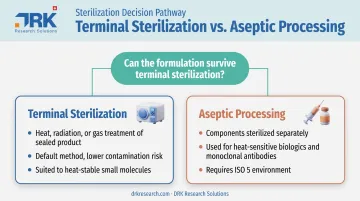
Every sterile program starts with a formulation question: can this molecule survive terminal sterilization, or does it need aseptic processing from the first step? FDA's position is direct on this point. Terminal sterilization is the default when feasible, and aseptic processing is reserved for products that can't tolerate it.
Heat-sensitive proteins, most monoclonal antibodies, and many biologics can't survive an autoclave cycle, so they route through aseptic fill. Small-molecule solutions that hold up under heat often go the terminal route instead, which carries lower contamination risk overall.
Getting this decision right requires real data:
- Thermal and radiation sensitivity studies show how the molecule responds to heat and radiation exposure
- Filter compatibility testing under worst-case bioburden conditions confirms filtration performance
- Autoclave cycle validation proves lethality without degrading the product
Lyophilization Capabilities
Many biologics aren't stable in solution long enough to reach a patient. Freeze-drying removes water without the excessive heat that would degrade the protein, extending shelf life from weeks to years in some cases.
Cycle development is where this gets technical. A CDMO needs to:
- Characterize the formulation's eutectic point
- Control freezing and ramp rates precisely
- Confirm uniform product temperature across every vial on the shelf
Inconsistent cycles produce cake collapse or uneven moisture content.
Testing doesn't stop once the cycle is validated. Finished lyophilized product needs:
- Dose uniformity checks
- Residual moisture testing
- Reconstitution performance testing through the maximum shelf-life claim
A product that reconstitutes perfectly on day one but clouds up at month eighteen is a failed program.
Packaging and Container Closure Selection
The primary package is part of the drug product, not an afterthought. Vials, pre-filled syringes, and cartridges each bring different material considerations, including Type I or II glass, polymer, or elastomeric stoppers, and each combination needs its own compatibility data.
Container closure decisions come with their own testing burden:
| Requirement | Purpose |
|---|---|
| Extractables & leachables | Checks whether the container sheds compounds into the formulation over time |
| Container closure integrity (USP <1207>) | Confirms the seal keeps contamination out for the entire labeled shelf life |
| Preservative efficacy (USP <51>) | Required for multi-dose products to prevent microbial growth after repeated puncture |
| In-use stability | Simulates repeated punctures and storage conditions a vial faces in clinical use |
Skipping these steps is a common reason multi-dose sterile products fail late-stage review.
Choosing the Right CDMO Partner for Sterile Dosage Forms
What to Evaluate Before You Sign
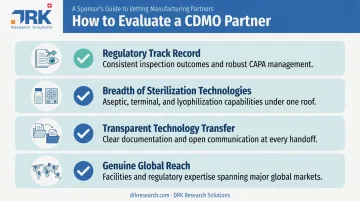
Choosing a sterile CDMO comes down to a handful of concrete checks, not marketing claims:
- Regulatory track record: inspection outcomes, warning letters, sterility failures, and CAPA effectiveness over time, not just certifications listed on a website
- Breadth of sterilization technologies: aseptic processing, terminal sterilization, and lyophilization capability under one roof, so the formulation dictates the method rather than the equipment on hand
- Transparent technology transfer: a documented transfer package with development reports, criticality assessments, and named teams on both sides
- Genuine global reach: actual operational presence in the regions where you plan to file, rather than a stated willingness to work there
Why an Integrated CRO-CDMO Model Reduces Risk
Sponsors who split formulation development, clinical trial execution, and commercial manufacturing across separate vendors absorb a lot of avoidable risk. Every handoff is a chance for documentation gaps, misaligned specifications, or timeline slippage.
An integrated CRO-CDMO model carries a product from early formulation through clinical development and into commercial launch under one governance structure, meaning fewer handoffs and fewer places for a project to stall.
DRK Research Solutions works this way. Since introducing CDMO services in 2022, the company has built generics and hybrid product development capabilities alongside its established CRO operations.
Its offering spans:
- Lab-scale formulation and analytical method development
- Technology transfer and exhibit batch manufacturing
- Commercial batch manufacturing and eCTD dossier preparation
With over a decade of clinical and regulatory experience across Europe, the Middle East, Asia, Africa, and the Americas, DRK's model gives sponsors continuity instead of re-litigating specifications with a new partner at every stage.
Frequently Asked Questions
What makes a dosage form require sterility?
Any route that bypasses the body's natural microbiome defenses, including injection, ophthalmic, intravitreal, or inhaled delivery, requires sterility to prevent introducing infection directly into tissue or the bloodstream.
What is the difference between aseptic processing and terminal sterilization?
Terminal sterilization treats the sealed final product, typically with heat, radiation, or gas. Aseptic processing sterilizes components separately and assembles them under controlled conditions; it's used when the formulation can't survive terminal treatment.
What regulatory standards must a CDMO follow for sterile drug manufacturing?
CDMOs must meet FDA cGMP and EU GMP Annex 1 at minimum, plus any regional framework relevant to the target market, such as MHRA or WHO PQ. Sponsors selling globally need a partner with genuine multi-region compliance experience.
Why is lyophilization used in sterile injectable products?
Freeze-drying removes water without excessive heat, stabilizing moisture- or heat-sensitive biologics that would degrade in solution. It extends shelf life and allows rapid reconstitution at the point of use.
How do I choose the right CDMO for sterile dosage form development?
Look at regulatory track record, breadth of sterilization technologies (aseptic, terminal, lyophilization), and whether the partner offers integrated CRO-CDMO capability that reduces handoffs between development and manufacturing.
What packaging options are available for sterile injectables?
Vials, pre-filled syringes, and cartridges are the most common formats, made from Type I/II glass, polymer, or elastomeric materials. Sponsors can choose ready-to-use components or bulk sterilization depending on production scale.