Many sponsors discover this the hard way: a validated clinical process suddenly produces failed batches, deviation reports, and stalled launch timelines, right when regulators and patients are waiting.
The pain point is structural. Small-scale processes are exploratory by design. Commercial-scale processes must be reproducible, batch after batch, indefinitely. Bridging that gap without compromising patient safety or regulatory standing takes a defined system, not good intentions.
This article breaks down what commercial batch manufacturing involves, how it differs from clinical-phase production, where scale-up commonly breaks down, and the best practices, including CDMO partnerships, that keep batches consistent once volume goes up.
Key Takeaways
- Commercial batches are fixed-quantity, GMP-produced drug lots with a unique traceable lot number
- Scale-up variability in mixing, heat transfer, and dissolution drives most commercial batch failures
- Process validation, QbD, and real-time monitoring (SPC/PAT) drive batch-to-batch consistency
- Multi-market regulatory divergence complicates scaling for global distribution
- CDMO partnerships with global regulatory reach cut technology transfer risk and time-to-market
What Is Commercial Batch Manufacturing?
Commercial batch manufacturing is the large-scale, GMP-controlled production of an already-approved drug product, made in discrete, fixed-quantity lots for market distribution. The FDA's process validation guidance draws a hard line here: material made for clinical trials or treatment INDs does not count as commercial manufacturing. Only product intended for market sale does.
Each batch gets a unique batch or lot number that ties together:
- Raw material sourcing and supplier lot records
- Process parameters used during that specific run
- QC test results and release data
That traceability isn't paperwork for its own sake. If a quality issue surfaces post-launch, the batch number lets manufacturers isolate exactly which lots are affected and pull them from the market fast, without recalling everything ever shipped.
Commercial batch manufacturing only starts after a product clears clinical trials and receives marketing authorization. Everything before that—exploratory batches, IND-stage supply, exhibit batches for registration—falls under a different regulatory framework with different validation expectations.
Examples of Commercial Batch Manufacturing in Practice
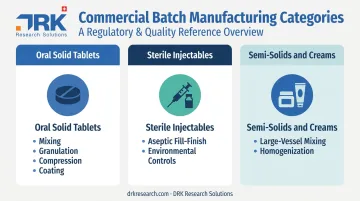
What this looks like varies by dosage form:
- Oral solid tablets: mixing, granulation, compression, and coating run at full commercial batch size, often hundreds of thousands of units per lot
- Sterile injectables: aseptic fill-finish operations producing thousands of vials or pre-filled syringes under strict environmental controls
- Semi-solids and creams: large-vessel mixing and homogenization for ointments, gels, and topical products
Generics and hybrid products for regulated markets rely heavily on this model. Generic medicines made up 70% of treatment volume in Europe in 2023, but only 19% of market value, according to IQVIA's analysis of generic medicine value. That volume-to-value ratio only holds up if manufacturers can produce consistent, high-quality batches at low cost and high scale.
Clinical Batch vs Commercial Batch Manufacturing: Key Differences
A clinical batch and a commercial batch might share the same formula on paper. In practice, they operate under entirely different rules.
| Factor | Clinical Batch | Commercial Batch |
|---|---|---|
| Scale | Small, exploratory | Full market volume |
| Regulatory status | Investigational (IND/IMPD) | Full marketing authorization |
| Validation | Incomplete, evolving | Reproducibility demonstrated across consecutive full-scale runs |
| Equipment | Flexible, lab or pilot scale | Dedicated GMP suites, higher automation |
| Documentation | Limited, trial-specific | Supports ongoing submissions and multi-market compliance |
In the US, IND sponsors submit CMC information under 21 CFR Part 312, and most Phase 1 drugs are exempt from finished-product rules in Part 211, though they remain subject to CGMP. In the EU, Investigational Medicinal Product GMP rules accommodate evolving process knowledge, features that don't fit a commercial validation model at all.
Process validation is where the biggest gap shows up. FDA's Process Performance Qualification (PPQ) must run on the qualified commercial facility, using commercial-scale equipment, personnel, and controls, and routine distribution should only begin after PPQ succeeds.
Batch count expectations vary by regulator:
- FDA sets no single fixed number, but expects enough runs, with adequate sampling, to build statistical confidence
- ICH Q7 points to three consecutive successful API batches as a common benchmark
- EU GMP Annex 15 expects at least three consecutive routine-condition batches at commercial scale, though a risk-justified alternative number is allowed
Equipment demands escalate too. Commercial-scale production needs validated cleaning procedures and changeover protocols, qualified specifically at that scale, not scaled-up pilot equipment. Documentation shifts accordingly, from single-trial support to batch records that feed ongoing submissions, stability commitments, and compliance checks across every market where the product sells.
The Commercial Batch Manufacturing Process: Key Stages
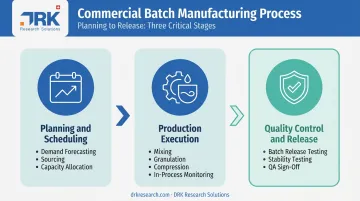
Commercial batch manufacturing moves through three broad stages, each with its own checkpoints.
Planning and Scheduling
Before a single ingredient is weighed, teams need demand forecasting tied to launch projections, raw material sourcing agreements at commercial volume, and capacity allocation across lines and sites. ISPE recommends prioritizing products by therapeutic and business significance, then assessing demand, supplier depth, and site interdependencies as conditions shift.
Production Execution
Once scheduling locks in, production runs through sequential steps: mixing, granulation, compression, or filling, depending on dosage form. Written production and process-control procedures govern every step, and in-process monitoring catches variability before it compounds. That includes checking:
- Tablet or capsule weight variation
- Blend and content uniformity
- Dissolution and disintegration
- pH and bioburden, where relevant
Quality Control and Release
No batch reaches the market without clearing three checkpoints:
- Batch release testing: laboratory confirmation the product meets specification
- Stability testing: ongoing monitoring under a written stability program to confirm shelf-life claims hold
- QA sign-off: the quality unit reviews the full batch record and investigates any discrepancy before release
In the EU, this final step includes Qualified Person certification, confirming manufacture and testing align with GMP and the marketing authorization before release. Skip depth at any of these stages, and the batch record will not hold up under a later deviation investigation.
Common Challenges in Scaling from Clinical to Commercial Batch Manufacturing
Scale-up rarely goes exactly to plan.
Process parameters don't scale linearly. Mixing time, heat transfer, and dissolution behavior that worked in a small vessel often change on commercial-scale equipment.
Vessel geometry and impeller speed alter powder collision patterns during granulation, even when power settings are normalized. Freeze-drying makes this obvious: copying lab set points onto a production dryer can cause vial breakage or product collapse, because heat transfer and sublimation capacity differ by scale.
Scaling up also strains sourcing: pharmaceutical-grade materials get harder to secure consistently. Larger volumes mean more suppliers, more lots, and more chances for variability, especially across international markets with differing supplier qualification standards.
Sourcing challenges compound regulatory ones. Regulatory complexity multiplies: US CGMP under Parts 210/211 differs procedurally from EU national inspections and QP certification, and UK MHRA licensing adds another layer. Sponsors expanding globally need a regulatory strategy built in from day one, not bolted on after the first submission gets flagged.
Common friction points sponsors report:
- Dissolution or blend uniformity shifting outside spec at full scale
- Supplier qualification delays when sourcing at higher volumes
- Diverging documentation requirements between FDA, EMA, and MHRA submissions
Best Practices for Ensuring Consistency at Scale
Consistency at commercial scale isn't an accident. It's built into process design long before the first commercial batch runs.
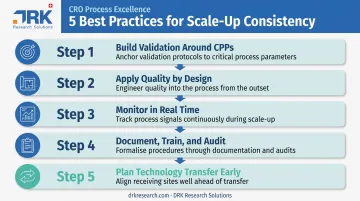
Build validation around defined CPPs. Establish Critical Process Parameters before full commercial rollout, and validate against them, not just against a finished-product spec. Validation batches should match intended commercial scale, typically at least three consecutive routine-condition batches, more if risk assessment calls for it.
Apply Quality by Design from early development. QbD means defining the quality target product profile, critical quality attributes and material attributes, and an approved design space for critical process parameters. Movement within that design space isn't considered a process change; movement outside it usually triggers formal post-approval change management, so getting the design space right early avoids friction later.
Monitor in real time. Statistical process control and Process Analytical Technology catch deviations while they're still correctable, not after the batch is finished. Continued process verification expects manufacturers to statistically trend both intra-batch and inter-batch data, with the quality unit reviewing results on an ongoing basis.
Document, train, and audit consistently. Consistency depends on:
- Detailed batch record systems that support full traceability and fast deviation investigation
- Internal audits and standardized operator training held steady across every site
- Strict GMP adherence that doesn't vary by location
Plan technology transfer early. Technology transfer between development and commercial sites is where consistency most often breaks down. Treating development, transfer, and commercial manufacturing as one continuous lifecycle, rather than separate silos, keeps process knowledge intact across the handoff.
How DRK Research Solutions Supports Consistent Commercial-Scale Manufacturing
DRK Research Solutions approaches commercial batch consistency as a bridge-building exercise, connecting sponsors to qualified manufacturing capacity rather than owning production lines directly.
- GxP-compliant CDMO services: DRK's CDMO division, launched in 2022, develops generics and hybrid products through partner facilities operating under GMP conditions compliant with FDA, EMA, and other global standards, reducing batch-to-batch variability at scale-up.
- Global regulatory reach: With hubs in Europe, the Middle East, Asia, Africa, and the Americas, DRK guides sponsors through local regulatory pathways. This includes eCTD dossier prep and GxP advisory across EU GMP, US FDA, MHRA, PIC/S, and WHO PQ standards.
- End-to-end integration: DRK manages the full journey from early development through commercial launch, covering analytical method development, technology transfer with on-site support at manufacturing partners, and exhibit-batch coordination.
For sponsors weighing where to scale up commercially, formulation expertise and regulatory strategy, paired with dependable manufacturing partners, typically matter more than any single capability alone.
Frequently Asked Questions
What is a commercial batch?
A commercial batch is a fixed-quantity, GMP-produced lot of an already-approved drug, manufactured specifically for market distribution. Each batch carries a unique, traceable lot number linked to its raw materials, process parameters, and QC results.
What are the key differences between clinical batch and commercial batch manufacturing?
Clinical batches are small, exploratory, and made under investigational approvals with incomplete validation. Commercial batches run at full market volume, require full marketing authorization, demonstrated process reproducibility, and documentation that supports ongoing multi-market compliance.
What is an example of batch manufacturing?
Examples include tablet production runs of hundreds of thousands of units and sterile injectable fill-finish operations producing thousands of vials. Large-vessel mixing for creams or ointments is another common example, with each run processed as a discrete, traceable lot.
How is consistency maintained across commercial batches?
Consistency relies on defined process validation built around Critical Process Parameters and Quality by Design principles applied early. Statistical process control and PAT enable real-time monitoring, while rigorous batch documentation supports traceability and audit readiness.
What regulations govern commercial batch manufacturing?
GMP requirements enforced by agencies like the FDA, EMA, and MHRA govern commercial batch manufacturing, alongside process validation expectations and formal batch release standards, including QP certification in the EU.
How long does it take to scale up from clinical to commercial batch production?
Timelines vary by product complexity and regulatory pathway. Scale-up typically involves months of process validation, technology transfer, and regulatory review before a product reaches commercial launch.