Digitalization in pharma means weaving AI, cloud platforms, automation, and connected data systems into R&D, manufacturing, and patient care. It's not a single tool or software rollout. It's a full rewiring of how drugs get discovered, tested, made, and delivered.
Nearly 60% of life-sciences executives planned to increase generative AI investment across their value chain in 2025, according to Deloitte's 2025 Life Sciences Outlook. That's not a niche pilot program anymore. It's board-level strategy.
This article breaks down the trends driving that shift, what's fueling the momentum, the real impact companies are seeing, and where things head next.
Key Takeaways
- AI, decentralized trials, and cloud compliance tools are reshaping every stage of pharma
- Nearly 60% of life-sciences executives plan to boost gen-AI spending this year
- Faster trial enrollment and expanded reach into underserved regions mark early wins
- Skills gaps remain pharma's biggest bottleneck, mismatching staff capability with job demands
Key Digitalization Trends Transforming the Pharmaceutical Industry
Digitalization doesn't sit in one department. It spans discovery labs, clinical sites, manufacturing floors, regulatory desks, and patient homes. Here are the five trends defining that shift right now.
AI-Powered Drug Discovery & Predictive Analytics
AI and machine learning models now mine massive datasets (genomic, chemical, clinical) to identify promising drug candidates, predict how compounds will behave, and simulate trial outcomes before a single patient enrolls. Work that once took research teams years can now happen in a fraction of the time.
Eli Lilly's 2025 collaboration with Insilico Medicine shows this in action. Insilico's Pharma.AI platform generates, designs, and optimizes compounds against targets Lilly selects, compressing early discovery work that traditionally required large teams and long timelines.
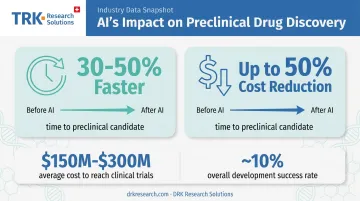
The economics explain why this trend has momentum. BCG estimates AI-enabled workflows can cut the time to reach a preclinical candidate by 30% to 50%, and lower costs by up to 50%. That matters because getting a drug to clinical trials now costs roughly $150 million to $300 million, nearly double what it cost a decade ago, with overall development success sitting near just 10%.
Two forces are pushing this trend forward: rising R&D costs that push companies to find efficiency wherever they can, and growing patient demand for faster access to novel therapies, especially for rare and life-threatening conditions.
Digitization & Decentralization of Clinical Trials
E-clinical platforms, ePRO (electronic patient-reported outcomes), and eTMF (electronic trial master file) systems are replacing paper-based trial management. Combined with remote and hybrid trial models, these tools digitize data capture, patient monitoring, and coordination across multiple countries at once.
This is where DRK Research Solutions' work comes into focus. As a CRO running Phase II–IV multi-regional trials across Europe, Asia, Africa, and the Americas, DRK relies on a digital backbone to keep multi-country studies coordinated and audit-ready.
That backbone includes electronic Case Report Forms (eCRFs) with built-in edit checks, Interactive Response System (IxRS) integration, and vendor data reconciliation across central labs, imaging, and pharmacokinetics sources. This kind of infrastructure becomes essential once a trial spans sites in low- and middle-income countries (LMICs) alongside established markets.
Adoption data backs up the shift. IQVIA found that 70% of surveyed CROs, pharma companies, and trial sites had participated in trials with at least one decentralized element, with usage peaking in 2021 and settling above pre-pandemic levels since.
This matters because it directly addresses three persistent trial headaches:
- Faster enrollment, since patients no longer need to live near a physical site
- Lower operational costs, by reducing travel, paper logistics, and redundant site visits
- Broader access, particularly for underserved and LMIC populations who were historically excluded from trial participation
Smart Manufacturing & Industry 4.0
Modern pharma plants increasingly run on IIoT-connected production lines and SCADA (Supervisory Control and Data Acquisition) systems, hardware and software combinations that monitor and control equipment in real time. Add digital twins, virtual replicas of physical production lines, and manufacturers can simulate batch runs before committing physical materials.
Sanofi's experience illustrates the payoff. The company reports that real-time analytics, automation, and AI across manufacturing and supply chain functions improved on-time-in-full performance by more than 10 points, alongside a program targeting a 70% reduction in the time needed to produce roughly 3,500 annual Product Quality Reports.
The significance here comes down to three outcomes:
- Fewer production errors caught earlier in the process
- Faster batch release cycles
- Stronger regulatory traceability, since every process step gets logged digitally
Cloud-Based QMS, RIM & DataOps for Compliance
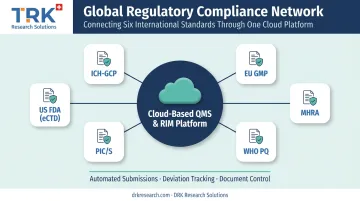
Quality management systems (QMS) and regulatory information management (RIM) platforms now centralize compliance data in the cloud, automating submissions, tracking deviations, and managing document control from one place instead of scattered spreadsheets and shared drives.
Veeva's RIM platform is a well-known example, unifying regulatory processes and data for end-to-end submission and registration management. On the CRO side, this kind of digitization touches eCTD dossier preparation directly. DRK Research Solutions applies frameworks including ICH-GCP, EU GMP, MHRA, WHO PQ, PIC/S, and US FDA standards when preparing Module 2–5 dossiers. That work depends on centralized, digitized regulatory data to stay accurate across multiple jurisdictions at once.
Why this keeps growing:
- Global regulatory complexity is increasing, not shrinking, as agencies expand digital submission requirements
- FDA guidance now requires covered applications to be submitted electronically in specified formats, including eCTD
- Companies face constant pressure to shorten approval timelines without cutting corners on quality documentation
Digital Patient Engagement & Real-World Data
Digital pills, patient portals, telemedicine visits, and real-world evidence (RWE) platforms let care teams monitor patients continuously rather than waiting for scheduled check-ins. That continuous view supports more personalized treatment adjustments.
A 2025 peer-reviewed study offers a useful data point: an AI-based smartphone intervention for stroke patients on anticoagulants, using medication identification, camera-confirmed ingestion, and reminders, achieved 100% adherence in the intervention group versus 50% in the control group. It's a small 28-patient study, so treat it as a promising signal rather than a universal benchmark; the same review notes many digital adherence tools show mixed results.
This trend directly supports DRK's origins. The company began in 2012 as a Patient Advocacy Organization focused on improving treatment access in underserved regions. That mission still shapes its patient-centric approach today, reaching more than 2 billion people living in LMICs. Digital tools that improve adherence and generate real-world evidence help close the same access gaps DRK was founded to address.
What's Driving These Digitalization Trends in Pharma
Several forces are converging at once, and no single one explains the pace of change on its own.
| Driver | What's happening |
|---|---|
| Technology advances | AI, automation, and IIoT have matured enough to make once-manual processes scalable |
| Market and patient demand | Patients and healthcare providers expect faster, more personalized, more transparent interactions |
| Cost pressure | Running a full clinical trial program now costs $150M–$300M, nearly double what it cost a decade ago, pushing companies toward efficiency tools |
| Regulatory expectations | The US Drug Supply Chain Security Act requires interoperable, electronic drug tracing, not optional paperwork |
| Competitive dynamics | Deloitte estimates AI investment could generate value equal to up to 11% of revenue over five years for biopharma companies |
Technology maturity often gets the most credit for this shift, but regulatory pressure deserves closer attention. Two forces matter most:
- Technology maturity explains why digitalization is possible now, not just desirable
- Regulatory mandates turn digitalization from choice to requirement: once agencies require electronic tracing or submission formats, non-compliance isn't an option
How These Trends Are Impacting the Pharma Industry
Digitalization is reshaping daily workflows, investment priorities, and hiring needs simultaneously. Here's how that plays out across three dimensions.
Operational Impact
Workflows are visibly changing on the ground:
- Trial cycles move faster with digital enrollment and remote monitoring replacing slower site-by-site recruitment
- Quality checks happen automatically instead of through manual batch-by-batch review
- Supply chains gain real-time visibility, letting teams catch disruptions before they cascade
Business Impact
Strategically, companies are shifting where their money goes. The share of life-sciences organizations budgeting more than $10 million for generative AI climbed from 13% in 2024 to 20% in 2025, according to McKinsey's life-sciences survey data.
That's a meaningful jump in just one budget cycle. It signals pilots are graduating into funded programs with clearer ROI expectations attached.
Workforce Impact
The people side is where the gap shows up most. Roughly 80% of pharmaceutical manufacturers report a mismatch between employee skills and evolving job requirements, per ISPE research.
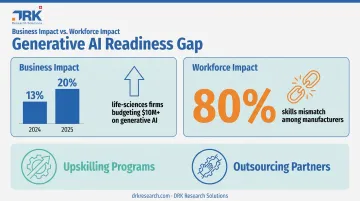
Companies are closing that gap in two ways:
- Building internal upskilling programs to reskill existing teams
- Outsourcing specialized digital and data functions to partners with expertise already in place
For many mid-sized sponsors, partnering with a CRO that already has digital trial infrastructure in place is faster than building that capability from scratch.
Future Signals for Digitalization in the Pharma Industry
The trends above aren't finish lines. Here's what's worth watching over the next one to three years.
Agentic AI and autonomous workflows. McKinsey notes nearly 8 in 10 companies now use generative AI, yet most report no tangible bottom-line benefit yet. The next phase is agentic AI, systems that redesign entire workflows rather than acting as simple copilots bolted onto existing processes.
Three technologies show where this shift toward agentic systems is headed:
- Generative AI for drug design – already the top strategic priority for 38% of surveyed life-sciences organizations building out their gen-AI roadmaps
- Digital twins for manufacturing – ISPE notes these can simulate and document process performance before a batch runs, though validation and model governance remain unresolved challenges
- Blockchain for supply chain traceability – FDA's completed DSCSA pilots evaluated blockchain among several options, but the agency requires interoperable electronic tracing, not any specific architecture
Likely near-term scenarios include deeper integration between decentralized trials and AI-driven site selection, letting sponsors identify the best-performing regions and populations before a study even launches.
Expect expanded digital health access in emerging markets too, as mobile-first tools make trial participation and patient monitoring possible in places that lacked the infrastructure just a few years ago.
Conclusion
Digitalization now touches every stage of the pharma value chain, from AI-assisted discovery to smart manufacturing floors to patients managing their own care through a phone app. None of these trends operate in isolation anymore.
Early adopters are already seeing measurable advantages in speed, compliance, and how far their therapies reach. Companies that wait risk falling behind on all three fronts at once.
Getting this right takes more than buying software. It takes strategic foresight and partners like DRK Research Solutions, who understand both the technology and the regulatory terrain across multiple markets. That combination, more than any single tool, will separate the pharma companies that thrive over the next decade from the ones playing catch-up.
Frequently Asked Questions
What are the main types of digitalization in pharma?
The main categories are AI-driven drug discovery, clinical trial digitization (e-clinical platforms, decentralized models), smart manufacturing (IIoT and SCADA systems), regulatory and compliance systems (cloud-based QMS and RIM), and digital patient engagement tools.
What is SCADA in pharma?
SCADA (Supervisory Control and Data Acquisition) is a combination of hardware and software used to monitor and control manufacturing equipment in real time. In pharma, it helps ensure batch consistency and provides the traceability regulators require.
How is AI transforming drug discovery in the pharmaceutical industry?
AI mines large datasets to identify promising drug candidates, predict outcomes, and simulate trials before human testing begins. Estimates suggest it can cut preclinical development time by 30-50% and costs by up to 50%.
What are the biggest challenges to digital transformation in pharma?
Skills shortages top the list, with roughly 80% of manufacturers reporting a mismatch between staff capabilities and job demands. Compliance concerns and organizational silos between departments also slow adoption.
How does digitalization improve clinical trials?
E-clinical platforms and decentralized trial tools speed up patient enrollment, reduce operational costs, and widen access to trials for people in underserved and low- and middle-income regions who previously couldn't participate.
What is the future outlook for digital transformation in the pharma industry?
Expect continued growth in agentic AI, generative AI for drug design, manufacturing digital twins, and connected data ecosystems. The next few years should shift focus from isolated pilots toward fully integrated, workflow-level transformation.