These issues aren't rare exceptions. A 2024 review in Acta Pharmaceutica Sinica B found that roughly 40% of approved drugs and nearly 90% of drug candidates are poorly water-soluble. That's a massive share of pipeline products carrying built-in formulation risk from day one.
Unresolved formulation problems delay timelines, inflate budgets, and ultimately push back the moment patients get access to new therapies. This article breaks down the most common formulation troubleshooting challenges sponsors face, and how experienced CDMOs solve them systematically rather than reactively.
Key Takeaways
- Solubility, stability, compressibility, and scale-up issues drive most formulation delays
- Root-cause analysis beats reactive fixes by combining scientific, analytical, and process expertise
- QbD, DoE, and specialized characterization help CDMOs solve problems once, not repeatedly
- Global regulatory reach and integrated development-to-manufacturing capabilities cut CDMO resolution time
Understanding Formulation Troubleshooting in Drug Development
Formulation is the science of converting an API into a dosage form patients can actually use safely, whether that's a tablet, capsule, topical cream, or injectable. It sounds straightforward. It rarely is.
Troubleshooting, in the pharmaceutical context, means something specific: a systematic, root-cause-driven process for identifying and fixing issues that threaten product quality, safety, timelines, or regulatory compliance. This can happen at any stage, from early bench work through commercial manufacturing.
Most formulation problems don't show up in the lab. They surface at transition points, where small process variables suddenly matter enormously:
- Lab to pilot scale
- Pilot to commercial scale
A formulation that behaved perfectly at 1 kg batch size can behave very differently at 200 kg.
This is exactly where deep CDMO process expertise earns its keep. Catching an issue before it reaches commercial scale is far cheaper than fixing it after a failed validation batch.
Top Formulation Troubleshooting Challenges (and How CDMOs Solve Them)
Challenge #1: Poor Solubility and Bioavailability
Low aqueous solubility is the the single biggest technical hurdle in modern drug development. A 2022 Pharmaceutics review reports that around 40% of new chemical entities run into formulation difficulties, with roughly 70% of novel medications showing low aqueous solubility.
Root causes usually trace back to:
- Crystalline structure that resists dissolution
- Large particle size limiting surface area contact with fluids
- Hydrophobic chemistry that repels aqueous media
CDMOs tackle this with a toolkit built specifically for BCS Class II and IV compounds:
- Particle size reduction through micronization or nanomilling to increase dissolution surface area
- Solid dispersion technology, dispersing the API in an amorphous, more soluble matrix
- Lipid-based delivery systems for compounds that dissolve better in fats than water
- Salt or co-crystal screening to identify a more soluble physical form of the same molecule
The right approach depends entirely on the molecule's specific chemistry, which is why in-house physicochemical characterization labs matter so much here.
Challenge #2: Stability and Degradation of Sensitive Ingredients
Some APIs simply don't like the real world. Hygroscopic compounds pull moisture from the air. Light-sensitive molecules break down under normal warehouse lighting. Thermally unstable ingredients degrade during routine processing or shipping.
Common failure triggers include:
- Humidity exposure during granulation or storage
- Temperature excursions in transit or warehousing
- Oxidative or photolytic degradation pathways nobody flagged early
ICH Q1A(R2) guidance requires stress testing across elevated temperature, humidity around 75% RH, oxidation, photolysis, and a wide pH range to identify these pathways before they become surprises. CDMOs apply this systematically:
- Forced degradation and stress testing to map every likely breakdown route
- Protective excipients such as desiccants and antioxidants built into the formulation
- Controlled manufacturing environments with humidity and light controls
- Stability-indicating analytical methods validated to detect degradation products, not just the parent compound
Skipping this step doesn't make instability go away. It just delays discovery until stability data collection is well underway.
Challenge #3: Flow, Compressibility, and Compaction Defects
Tablet compression looks simple until it isn't. Sticking, picking, capping, and lamination are the four defects that quietly wreck batch yield and quality on the manufacturing floor.
Sticking happens when material adheres to the punch face rather than releasing cleanly. Picking is a localized version, where material sticks around engraved letters or logos. Capping and lamination involve the tablet separating along internal planes, often from trapped air or ejection stress in convex tablets.
Root causes typically involve:
- Uneven particle size distribution feeding the tablet press inconsistently
- Insufficient binder or lubricant levels
- Incorrect compression force or turret speed for that particular formulation
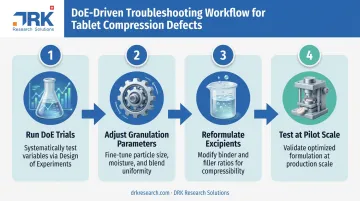
CDMOs resolve these defects through structured process work rather than guesswork:
- Run DoE-driven trials to isolate which variable (force, speed, moisture) actually causes the defect
- Adjust granulation parameters to improve flow and particle uniformity
- Reformulate excipients where binder or lubricant levels are the culprit
- Test at pilot scale before committing to a full commercial run
Challenge #4: Scale-Up and Technology Transfer Failures
A formulation that performs beautifully at lab scale can fall apart the moment it hits pilot or commercial equipment. This is one of the most common and most expensive troubleshooting scenarios in the industry.
A peer-reviewed granulation review points out why: scale-up changes powder mass and volume, container geometry, impeller and chopper size, and operating speed ranges. Even with a fixed formulation, those process shifts can alter product quality.
The underlying issue is almost always a mismatch in:
- Mixing shear between small and large equipment
- Heat transfer rates across different vessel sizes
- Residence time as batch volumes grow
CDMOs address this through frameworks defined in ICH Q8(R2):
- QbD frameworks with a defined design space, mapping which process parameters can flex without risking quality
- Equipment-matched trial runs, testing on machinery that mirrors the intended commercial line
- Structured technology transfer protocols that formally bridge R&D and manufacturing teams, rather than relying on informal handoffs
Challenge #5: Analytical Method and Dissolution Testing Gaps
Not every dissolution method actually tells you what you need to know. A method that isn't discriminating enough can mask a real formulation problem until it surfaces late, sometimes during regulatory review, which is the worst possible time to find it.
This gap usually comes from:
- Dissolution methods copied from a similar product rather than tailored to this specific API and dosage form
- A lack of biorelevant testing media that reflects actual gastrointestinal conditions
- Too few sampling time points to fully capture the drug release profile
FDA guidance recommends physiological dissolution conditions with mild agitation wherever possible, specifically because that combination gives the strongest discriminatory power between good and bad batches.
CDMOs close this gap through:
- Rigorous method development and validation built around the specific molecule, not a generic template
- Biorelevant dissolution testing using media that mimics fasted or fed gastrointestinal conditions
- Integrated QC infrastructure that flags discrepancies during development, well before submission
Why the Right CDMO Partner Makes All the Difference
Troubleshooting formulation problems takes more than a quick fix. It demands a partner whose scientific, analytical, and regulatory expertise spans the entire development lifecycle, not just one narrow piece of it.
This is where DRK Research Solutions approaches things differently. DRK offers end-to-end generics and hybrid product development for regulated markets, supported by a global network of strategic alliances spanning Europe, the Middle East, Asia, Africa, and the Americas.
What sets this apart:
- Lab-scale formulation development, analytical method development and validation, and technology transfer coordination happen under one roof
- A network of EU- and US-approved manufacturing partners handles scale-up and commercial batch production under GMP conditions
- Over a decade of experience and 100+ professionals across clinical and pharmaceutical development functions
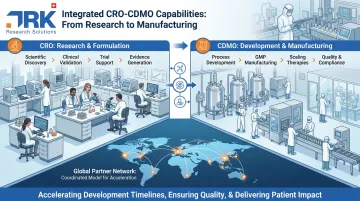
DRK's integrated CRO-CDMO model means insights from clinical development can inform manufacturing troubleshooting directly, rather than getting lost between separate vendors. That coordination shortens timelines and reduces costly rework.
Patient-centric thinking factors in here too: formulation solutions get evaluated for affordability and accessibility in underserved markets and LMICs, not just technical feasibility. A formulation fix that's brilliant but unaffordable in a target market isn't really a solution.
Best Practices to Prevent Formulation Issues Before They Start
Troubleshooting is necessary, but prevention is cheaper. Sponsors who invest upfront avoid most of the fire drills described above.
- Characterize the API thoroughly before formulation design begins — particle size, polymorphism, and solubility profiling upfront reveal issues while they're still easy to fix
- Build QbD and DoE into the process from day one rather than treating them as troubleshooting tools applied only after something breaks
- Bring a CDMO partner in early, not just at scale-up, so equipment realities and process constraints shape formulation design from the start
Early engagement means fewer surprises at the transition points where most formulation problems actually surface.
Frequently Asked Questions
What do you mean by formulation?
Formulation is the process of combining an active pharmaceutical ingredient with excipients to create a safe, stable, and effective dosage form, such as a tablet, capsule, or injectable.
What is troubleshooting in the pharmaceutical industry?
It's the systematic process of identifying, analyzing, and resolving issues that affect product quality, safety, or regulatory compliance during development or manufacturing.
What are the typical steps in a formulation troubleshooting process?
The process typically involves problem identification, root-cause analysis, corrective action or reformulation, and verification through testing to confirm the fix actually works.
Which type of technical challenges are encountered during drug formulation?
The most common technical issues are solubility limitations, stability and degradation risks, flow and compressibility defects, and scale-up or technology transfer failures.
What is the difference between a CRO and a CDMO?
A CRO focuses on clinical research services like trial management and data collection, while a CDMO handles product development and manufacturing. Integrated providers like DRK offer both under one partnership.
How long does formulation troubleshooting typically take during drug development?
Timelines vary widely by issue complexity. Minor process adjustments might take a few weeks, while major reformulation efforts, including added stability studies, can take several months.