Introduction
A drug candidate can have flawless pharmacology and still die in formulation. Not because the molecule is wrong, but because nothing on the excipient shelf can support it.
Formulators are seeing this more often. Poorly soluble APIs now dominate development pipelines. Biologics need delivery systems that didn't exist a decade ago, and modified-release formulations push materials well past their original design limits. Standard, pharmacopeial excipients weren't built for these molecules.
This creates a real bottleneck: teams spend months screening every commercially available excipient grade, only to hit the same wall. Solubility doesn't improve. Stability data won't hold. Compatibility issues persist.
This article breaks down when standard excipients fail, the two paths to custom development, the benefits worth the investment, the regulatory groundwork required, and how to know if custom development is your next step.
Key Takeaways
- Solubility, stability, compatibility, and release problems often demand excipients beyond pharmacopeial options
- Modifying an existing excipient costs less and moves faster than building a novel one
- Root-cause analysis comes first — custom development is not the default choice
- Safety documentation and compendial testing determine whether a custom excipient is ready for development
When Do Standard Excipients Fall Short?
Formulation failure often traces back not to the API itself but to the excipient system supporting it. Poor aqueous solubility, weak physical or chemical stability, and drug-excipient incompatibility cause most of the roadblocks formulators encounter.
Common warning signs include:
- Sensitivity to moisture, oxidation, light, or heat that degrades the active ingredient
- Poor powder flow or compressibility that undermines tablet manufacturing
- Inconsistent dose uniformity batch to batch
- Unpredictable interactions with excipients that work fine for other molecules
Which Formulations Hit This Wall Most Often
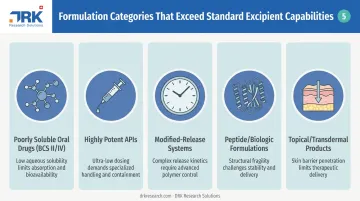
Certain product categories run into these limits more often than others:
- Poorly soluble oral drugs (BCS Class II and IV compounds)
- Highly potent APIs requiring precise, low-dose delivery
- Modified-release systems needing exact release kinetics
- Peptide and biologic formulations sensitive to shear, pH, and temperature
- Topical or transdermal products requiring specific permeation profiles
The scale of this challenge is reflected in market growth. The global pharmaceutical excipients market was valued at USD 11.03 billion in 2025 and is projected to reach USD 14.86 billion by 2030, a 6.1% CAGR. That growth signals rising demand for materials that do more than fill space in a formulation.
Switching between existing grades of the same excipient often isn't enough. When the barrier is molecule-specific rather than formulation-specific, generic substitution rarely works. That's when custom development becomes a genuine consideration rather than a fallback.
What Is Custom Excipient Development? Two Strategic Approaches
Custom excipient development means designing, modifying, or synthesizing a material engineered around one specific formulation problem, rather than swapping in a generic alternative from another supplier.
There are two routes to get there, and they carry very different cost and risk profiles.
Modifying an Existing Excipient
This approach chemically alters an established excipient's structure, often by introducing new functional groups, to create a derivative with improved properties.
Real-world examples:
- Cellulose derivatives, such as hydroxypropyl methylcellulose (hypromellose), modified for enhanced binding, coating, gelling, or controlled-release performance
- Cyclodextrin derivatives, including hydroxypropyl-beta-cyclodextrin and sulfobutylether-beta-cyclodextrin, engineered to dramatically boost aqueous solubility for poorly soluble drugs
- Chitosan derivatives, modified for mucoadhesive strength in nasal, ocular, or buccal delivery systems
This route is lower-risk and faster because it builds on the parent excipient's existing safety and performance history. Regulators already have data on the base material, which shortens the justification burden considerably.
Creating a Novel Chemical Entity
Sometimes modification isn't enough. The formulation problem demands something built from the ground up, with no existing base structure to lean on.
The process typically involves:
- Defining the base chemical moiety needed for the target function
- Screening chemical structure classes for candidate materials
- Optimizing for the specific characteristics the formulation requires
- Running quality control checks at every development stage
This is the higher-risk, higher-reward path. A peer-reviewed 2021 AAPS analysis found that a novel excipient typically takes 6 to 7 years to develop, followed by another 3 to 4 years before it's incorporated into an approved drug product. That's a decade-long commitment, reserved for cases where modification genuinely can't solve the problem.
Key Benefits and Applications of Custom Excipients
When custom development is the right call, the payoff shows up across several formulation dimensions.
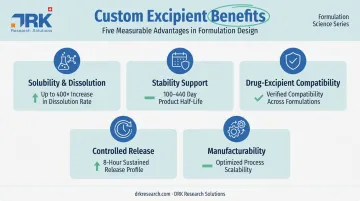
Solubility and dissolution. Custom materials can be engineered for better wetting, dispersibility, and molecular interaction with poorly soluble APIs. Published studies on cyclodextrin complexation report solubility gains ranging from 33-fold for dexamethasone to over 400-fold for saquinavir, depending on the drug-cyclodextrin pairing.
Stability support. Tailored excipients can slow degradation pathways tied to moisture, oxidation, light, or heat. In one documented case, a cyclodextrin-complexed compound went from undetectable aqueous solubility to a solid-complex half-life of roughly 100 days at room temperature and 440 days when refrigerated.
Drug-excipient compatibility. Custom design can minimize the interaction issues that otherwise stall development or compromise product integrity late in the process.
Controlled release. Co-processed excipients can deliver release profiles standard grades can't match. One study combining solid lipid nanoparticles with dicalcium phosphate dihydrate extended drug release to 8 hours, compared to complete release within the first hour for the unmodified formulation.
Manufacturability. Better flow, compressibility, and viscosity control support reproducible performance once a product moves to commercial-scale batches.
Where these benefits matter most:
- Poorly soluble oral formulations
- Modified-release drug products
- Biologic and peptide delivery systems
- Topical, transdermal, and semisolid products
- Advanced polymer-based delivery platforms
The Development Process: Regulatory and Quality Considerations
A custom excipient has to clear a specific technical bar before it's usable in a real drug product. It must demonstrate:
- Functional performance matching the intended dosage form
- Compatibility with the API and the rest of the formulation
- Stability over time under the intended storage conditions
- Batch-to-batch reproducibility
- Scalability from lab quantities to commercial volumes
The Documentation Burden
Getting a custom excipient development-ready requires substantial paperwork:
- Full composition and impurity analysis
- Compendial testing against USP, EP, BP, or JP standards
- Residual solvent and elemental (metals) testing
- Stability data covering the intended storage and shelf-life conditions
Here's something formulators sometimes miss: excipients aren't independently "approved" the way active ingredients are.
According to IPEC-Americas, there is no FDA regulatory approval system exclusively applicable to pharmaceutical excipients. Regulators evaluate safety and functionality data as part of the overall drug product application, determining the required evidence case by case.
That single fact changes how sponsors should plan. A custom excipient's fate ties directly to the drug product it supports. If the safety justification or compendial documentation isn't airtight, the entire application stalls, not just the excipient component.
This is exactly why analytical and regulatory expertise needs to be involved from day one, not bolted on after formulation work is finished.
DRK Research Solutions pairs formulation scientists with regulatory strategists at the outset of custom excipient projects, aligning early on what data package a target market will require. That alignment prevents expensive rework during scale-up, when changes are far costlier to make.
Is Custom Development Right for You? Choosing the Right Partner
Custom excipient development isn't always the answer. Sometimes it's the wrong one.
Skip custom development when:
- An existing pharmacopeial or co-processed excipient already solves the formulation problem
- The real issue is process-related (mixing, granulation, drying) rather than material-related
- A simpler grade change or supplier switch resolves the barrier
The decision should always follow a clear root-cause analysis. Is the failure driven by solubility, stability, compatibility, or release performance? Skipping this diagnostic step and jumping straight to custom synthesis wastes time and budget on a problem that a formulation tweak might have solved.
What to Look For in a Development Partner
Once custom development is genuinely warranted, the partner you choose matters as much as the material itself. Look for integrated capabilities across formulation science, synthesis, analytical testing, and regulatory strategy under one roof. Splitting these functions across multiple vendors introduces technology-transfer risk and adds months to timelines that are already long.
This is where DRK Research Solutions' combined CRO and CDMO model fits the picture. DRK pairs lab-scale formulation development and analytical method development with technology transfer, exhibit and commercial batch manufacturing, and eCTD dossier preparation. Regulatory strategy is built in from the start, aligned with ICH, USP, EU GMP, and FDA standards.
DRK's regulatory network spans Europe, the Middle East, Asia, Africa, and the Americas, with specific experience preparing dossiers for complex generics and hybrid products. That reach lets DRK guide sponsors from initial problem diagnosis through a scalable, regulatory-ready formulation.
Frequently Asked Questions
Do excipients need FDA approval?
No. Excipients aren't independently FDA-approved; they're reviewed as part of the drug product application. Novel excipients require additional safety justification and documentation to support that review.
What is the role of R&D in pharma?
R&D drives discovery, formulation, and optimization of drug candidates. This includes solving material-level challenges like excipient selection to ensure the final product is safe, effective, and manufacturable at scale.
What are the future trends in excipient development?
Expect growth in naturally derived biopolymers like nanocellulose, AI-driven formulation modeling for predicting solubility and stability, and co-processed multifunctional excipients. Demand from biologics and personalized medicine is accelerating all three trends.
What's the difference between modifying an existing excipient and creating a new chemical entity?
Modification builds on an established excipient's safety data, making it faster and lower-risk. Creating a novel chemical entity starts from scratch, requiring far greater investment and timelines of 6 to 8 years.
How long does custom excipient development typically take?
Modification-based approaches can move considerably faster since they build on existing safety data, often completing within 2 to 3 years. Fully novel excipients require the full 6 to 8 year development timeline, plus several more years before incorporation into an approved product.
When should a formulation team consider custom excipients over standard options?
Custom excipients become worth considering when persistent solubility, stability, or compatibility failures survive thorough process optimization and standard excipient screening. If root-cause analysis rules out process fixes, custom development becomes the logical next step.