Manufacturers can't afford to get this wrong. A single failed test can freeze an entire batch release, trigger a formal investigation, and delay product availability by weeks. Regulators back this up with hard numbers: EU GMP Annex 1 requires terminally sterilized products to achieve a Sterility Assurance Level of 10⁻⁶ or better, meaning no more than one non-sterile unit per million.
This article breaks down how sterility testing actually works, where it fits into the broader sterile manufacturing process, and the practical challenges sponsors run into along the way.
Key Takeaways
- Sterility testing statistically infers the absence of viable microorganisms, not absolute sterility.
- USP
<71>and EU GMP Annex 1 govern the two dominant methods: membrane filtration and direct inoculation. - A minimum 14-day incubation period is non-negotiable before issuing a "sterile" result.
- False positives and antimicrobial interference remain persistent hurdles, particularly with complex device geometries.
- Experienced CRO partners help sponsors integrate testing timelines into overall product development plans.
What Is Sterility Testing for Drug Products?
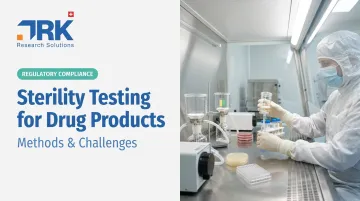
Sterility testing is a compendial microbiological release test. It samples a portion of a batch, cultures it, and checks for microbial growth. A passing result means no contaminating organism was detected in the units tested under the stated conditions, not that every single unit in the batch is guaranteed sterile.
That distinction matters more than most people realize. FDA guidance illustrates the limitation with a stark example: testing just 20 units from a 10,000-unit lot contaminated at 0.1% still gives that lot a 98% chance of passing. Sampling has real limits.
This is why sterility testing never operates alone. It runs alongside:
- Validated sterilization processes (terminal heat, gamma irradiation, or aseptic filtration)
- Environmental monitoring programs in cleanrooms and filling suites
- Process validation and contamination control strategies
Both aseptically processed and terminally sterilized products require this final test, though the sampling rationale differs slightly between the two. Increasingly, manufacturers are also exploring rapid or alternative microbial methods (RMM) to shorten quarantine times, though adoption remains uneven and product-specific rather than industry-wide.
Why Sterility Testing Is Critical for Drug Safety and Compliance
For injectables, biologics, and implantable products, sterility testing sits at the intersection of patient safety and regulatory approval. Without it, there's no lot release, no market access, and no protection for the patient receiving that dose directly into their bloodstream or tissue.
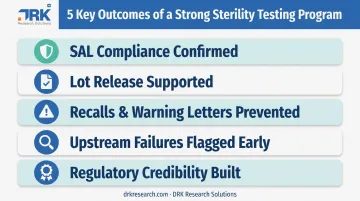
Here's what a properly executed sterility program accomplishes:
- Confirms SAL compliance before any unit reaches a patient
- Supports lot release under FDA (21 CFR 211.167 and 610.12), EMA, and USP/EP/ISO compendial standards
- Protects against recalls and warning letters that damage both patient trust and manufacturer reputation
- Flags upstream failures early — a positive result often points to a process or environmental control gap, not just a bad sample
- Builds credibility with regulators and healthcare providers who rely on consistent, documented quality
One real-world case: in 2019, Premier Pharmacy Labs recalled all unexpired sterile products after determining sterility assurance couldn't be confirmed. That single decision affected the company's entire product line, underscoring how much rides on a functioning sterility program rather than an isolated test result.
Sterility Testing Methods: Step-by-Step Process
Regulatory guidance dictates method selection through a specific, non-negotiable sequence. Most testing errors trace back to poor sample handling, rushed interpretation, or skipped method suitability studies, rather than genuine product contamination.
Aseptic Processing vs. Terminal Sterilization
Aseptic processing sterilizes individual components separately, then assembles them under tightly controlled cleanroom conditions. Terminal sterilization, by contrast, treats the fully sealed final product with heat, radiation, or gas.
This distinction shapes everything downstream:
- Sampling plans differ based on where contamination risk is highest
- Aseptically filled products typically require sampling from the beginning and end of a fill run
- Terminally sterilized batches are assessed as sublots, with each requiring its own separate sterility test
Selecting the Right USP <71> Method
Two compendial approaches dominate:
- Membrane filtration — the preferred method whenever the product allows it. Product passes through a filter with a pore size no greater than 0.45 µm, which traps any organisms present. The filter is then transferred to growth media.
- Direct inoculation — used for non-filterable products like ointments, creams, suspensions, and bulk solids. The product is added straight into culture media, typically not exceeding 10% of the medium's volume.
A third technique, product flush, applies specifically to hollow or complex medical device geometries, recovering potential contamination trapped inside lumens or channels before incubation begins.
Method Suitability and Validation
Before any product can be routinely tested, the lab must prove the method actually works on that specific formulation. This is bacteriostasis/fungistasis (B/F) validation.
The process involves spiking the product with known challenge organisms, such as Staphylococcus aureus, Pseudomonas aeruginosa, Candida albicans, and Bacillus subtilis, at no more than 100 CFU. If the product inhibits growth (common with preserved formulations or antimicrobial actives), the lab must adjust through:
- Additional membrane washes
- Product dilution
- Validated neutralizing agents
Validation requires repeating whenever formulations, sample types, or procedures change, and every terminally sterilized sublot needs its own independent test.
Incubation, Monitoring, and the 14-Day Standard
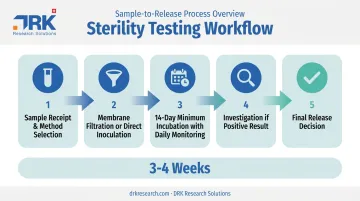
Once suitability is confirmed, samples move into two growth media: Fluid Thioglycollate Medium (FTM), which favors anaerobic and aerobic bacteria, and Soybean-Casein Digest Medium (TSB/SCDM), which supports fungi and aerobic organisms.
Incubation runs for a minimum of 14 days. That extended window accounts for slow-growing or fastidious organisms, which need the full 14 days to become detectable. Cutting it short risks a false-negative result that lets contaminated product through.
During incubation, technicians:
- Visually inspect for turbidity daily
- Run negative controls alongside test samples
- Document any growth immediately
A positive result triggers a documented root-cause investigation to determine whether contamination originated in the product or crept in during testing itself, rather than signaling an automatic batch failure. In practice, once you add sample preparation, the 14-day incubation window, and any follow-up investigation, sponsors commonly see total turnaround stretch to roughly three to four weeks from sample receipt to final release decision.
Key Challenges in Sterility Testing
Even a well-designed sterility program runs into recurring friction points. Understanding them helps sponsors plan realistic timelines and avoid unnecessary batch rejections.
- False positives: Contamination introduced by lab personnel, equipment, or the testing environment itself can mimic a genuine product failure. Rigorous aseptic technique paired with active environmental monitoring (EM) programs helps distinguish a testing artifact from true product contamination, though regulators require conclusive documented evidence before dismissing a positive result as invalid.
- False negatives: Preservatives and antimicrobial excipients can suppress microbial growth just enough to mask real contamination. This is precisely why B/F validation and neutralization steps exist; skipping them creates blind spots.
- Recovery limitations: Complex container-closure systems, combination products, and devices with hard-to-reach internal geometries make it genuinely difficult to recover organisms during sampling, regardless of how careful the technique is.
- Extended timelines: Between the mandatory 14-day incubation and any investigation that follows a positive result, sterility testing frequently becomes the single longest step standing between manufacturing completion and product release. That bottleneck strains supply chain planning, especially for products with tight shelf lives.
- Regulatory scrutiny: The revised EU GMP Annex 1 raised the bar considerably, requiring a facility-wide Contamination Control Strategy (CCS) covering everything from facility design and personnel practices to validation and continual improvement. A passing sterility test no longer stands on its own; it has to sit within a documented, defensible CCS.
How DRK Research Solutions Can Help
Sterility testing rarely happens in isolation. It's one piece of a much larger development and regulatory puzzle, and getting the surrounding strategy wrong often causes more delay than the test itself.
DRK Research Solutions works with sponsors developing sterile, generic, and hybrid products across a multi-regional network spanning Europe, the Middle East, Asia, Africa, and the Americas. Rather than treating sterility testing as an isolated checkbox, DRK helps sponsors position it correctly within formulation development, method validation, and regulatory submission timelines.
What sets DRK's support apart:
- Regulatory depth across FDA, EMA, MHRA, PIC/S, and WHO PQ frameworks, helping sponsors select appropriate methods and avoid costly investigation delays
- A global partner network with localized proficiency, connecting sponsors to qualified manufacturing and testing partners in each operational region
- End-to-end CDMO support, spanning lab-scale formulation, analytical method development, technology transfer, and batch release, keeping sterility considerations aligned with the broader product timeline
- Over a decade of patient-centric experience helping sponsors bring sterile and injectable products to underserved markets faster

For sponsors weighing method selection, formulation risk, or how sterility fits into an eCTD submission strategy, DRK's team can help map out the right approach before testing begins, not after a batch fails.
Frequently Asked Questions
How is drug sterility testing performed?
Samples are tested via membrane filtration or direct inoculation, then incubated for at least 14 days in FTM and TSB media. Technicians monitor for microbial growth throughout, confirming sterility per USP <71>.
Why is drug sterility testing conducted for 14 days?
The 14-day window gives slow-growing or fastidious microorganisms enough time to proliferate and become detectable. Cutting incubation shorter increases the risk of a false-negative result.
What are the two types of drug sterility testing?
Membrane filtration works for filterable products like aqueous or oily solutions. Direct inoculation applies to non-filterable products such as creams, ointments, and suspensions.
What are the USP guidelines for drug sterility testing?
USP <71> Sterility Tests defines the compendial methods, method suitability requirements, sampling plans, and acceptance criteria used for lot release testing of sterile drug products.
What happens if a sterility test result is positive?
A positive result triggers a formal investigation to determine whether contamination came from the product or the testing process. Without conclusive evidence of a lab error, the batch is rejected as non-sterile.
How long does the sterility testing process take?
Between incubation, daily monitoring, and any follow-up investigation, the full process typically spans three to four weeks from sample receipt to final release decision.