
This guide is written for pharmaceutical and biopharmaceutical companies, CDMOs, and regulatory affairs teams navigating drug development. Stability data determines shelf life, informs packaging decisions, and protects patients from degraded or ineffective medicines.
Here's the problem: stability testing gets referenced constantly in regulatory filings, yet it's often misunderstood at the operational level. What actually happens inside those chambers? Why does one product need three years of data while another needs twelve months? This article breaks down how the process works, what influences it, and when different approaches apply.
Key Takeaways
- Stability testing measures chemical, physical, microbiological, and toxicological changes under controlled conditions.
- ICH Q1 guidelines govern submissions to the FDA, EMA, and other major regulators worldwide.
- Long-term, intermediate, and accelerated studies each answer a different question about shelf life.
- API properties, packaging, climatic zone, and batch scale all influence outcomes.
- Reduced designs like bracketing and matrixing can apply when scientifically justified.
What Is Stability Testing and Why Is It Used in Drug Development?
What Is Stability Testing?
Stability testing is a formal study protocol that measures how a drug substance or product's identity, strength, quality, and purity change over time under specified storage conditions. The goal isn't just observation. It's establishing three concrete outcomes:
- A re-test period (for drug substances) or shelf life (for drug products)
- Appropriate storage conditions for the label
- Packaging and container closure requirements
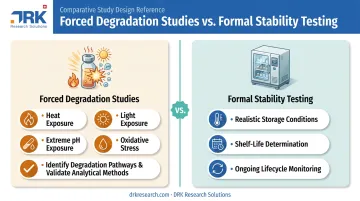
People often confuse this with forced degradation studies. They're not the same thing. Forced degradation deliberately stresses a sample under harsh conditions such as heat, light, extreme pH, and oxidation, to identify degradation pathways and validate analytical methods. Formal stability testing, by contrast, uses realistic storage conditions to determine how long a product actually stays within spec on the shelf.
Why Stability Testing Is Used in Pharmaceutical Development
Stability testing exists because regulators require it, but also because it solves real development problems. ICH Q1A(R2) generally requires data from at least three primary batches and at least 12 months of long-term data at the time of submission. This standard is adopted by the FDA, EMA, and other major regulatory authorities worldwide.
What stability testing addresses in practice:
- Consistency of potency across the product's proposed shelf life
- Safety across climatic zones (Zones I through IV), since a product shipped to a hot, humid region faces different degradation pressure than one stored in a temperate market
- Reliable expiration dating that reflects actual chemical behavior, not guesswork
Without proper stability data, things go wrong quietly. Degradation products go undetected until they show up in a complaint, and storage conditions get mislabeled, leading to premature potency loss in the field. Worst case, toxic impurities accumulate without anyone catching it until it becomes a safety signal.
Stability testing isn't a box-ticking exercise. It's embedded throughout the product lifecycle as both a regulatory mandate and a genuine quality safeguard.
How Stability Testing Works (Conceptual Flow)
At a high level, the process runs from protocol design through storage, periodic testing, and data evaluation, ending with an established shelf life. It requires representative batches, a defined protocol, validated stability-indicating analytical methods, and the intended container closure system.
Teams store samples under long-term, intermediate, and accelerated conditions, then pull them at scheduled intervals for testing. Calibrated stability chambers control temperature, humidity, and light exposure according to ICH-defined climatic zone parameters. The accumulated data reveals degradation trends, which then define the shelf life, storage statement, and packaging requirements on the final label.
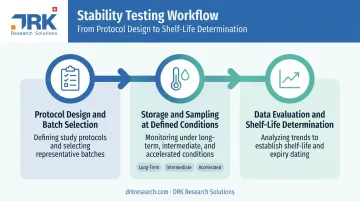
Step 1: Protocol Design and Batch Selection
A stability protocol defines the batches (typically at least three primary batches), the storage conditions, testing intervals, and the stability-indicating critical quality attributes to be monitored. This step sets the entire study's foundation. Get it wrong here, and the resulting data won't hold up during regulatory review.
Step 2: Storage and Sampling at Defined Conditions
Teams place samples under three standard condition sets and test them at scheduled intervals, commonly 0, 3, 6, 9, and 12 months.
| Study Type | Storage Condition | Minimum Data at Submission |
|---|---|---|
| Long-term | 25°C ± 2°C / 60% RH ± 5% RH | 12 months |
| Intermediate | 30°C ± 2°C / 65% RH ± 5% RH | 6 months |
| Accelerated | 40°C ± 2°C / 75% RH ± 5% RH | 6 months |
If sponsors select 30°C/65% RH as the long-term condition, they don't need a separate intermediate condition.
Step 3: Data Evaluation and Shelf-Life Determination
Teams statistically evaluate the collected data for degradation trends. Teams then use these results to establish, or extrapolate, the re-test period, shelf life, and storage labeling. Regulators permit extrapolation beyond available long-term data only when it's statistically and scientifically justified. Accelerated results alone can't carry that weight.
Where Stability Testing Is Applied and What Affects Its Outcomes
Where Stability Testing Is Applied
Stability testing spans nearly every dosage form:
- Tablets and capsules
- Injectables and sterile products
- Biologics and biosimilars
- Combination drug-device products
- Semi-solids, inhalation products, and oral liquids
It also recurs across the product lifecycle rather than happening once. Testing occurs during early development, at formal regulatory submission, through post-approval commitment studies, and in ongoing annual stability programs. New formulations, packaging changes, and manufacturing site transfers all trigger fresh stability work. This isn't a one-and-done activity.
Key Factors That Affect Stability Testing Outcomes
Several variables shape how a stability program is designed and how its results turn out:
- Inputs and materials: intrinsic API properties, excipient interactions, and moisture sensitivity
- Operating conditions: temperature, relative humidity, and light exposure during storage and shipment
- Equipment dependencies: calibrated chambers and validated, stability-indicating analytical methods
- Scale considerations: differences between development-scale, pilot-scale, and production-scale batches
- Climatic and regulatory constraints: storage conditions vary by ICH Climatic Zone; hot, humid markets often require 30°C/75% RH instead of the standard 40°C/75% RH accelerated condition
Getting climatic zone assumptions wrong is one of the more common missteps sponsors make when planning for multi-region approval. A condition that works for a European filing won't necessarily satisfy a regulator in a hot/humid market.
This is where experienced CRO/CDMO partners add real value. DRK Research Solutions supports sponsors through analytical method development for stability-indicating assays, formulation work that treats stability as a design criterion from day one, and eCTD dossier preparation that incorporates stability data packages into Module 2–5 submissions.
For sponsors managing programs across multiple regulatory regions, that kind of integrated support helps keep stability data generation aligned with each market's expectations.
Common Issues, Misconceptions, and When Full Stability Testing May Not Be Appropriate
A few misunderstandings surface repeatedly in stability programs, and they're worth clearing up directly.
Accelerated data alone doesn't confirm shelf life. Accelerated studies use exaggerated conditions to predict degradation quickly, but results aren't always predictive of physical change. They support extrapolation and inform development decisions, but long-term, real-time data remains the primary evidence for a supported shelf life.
Forced degradation and formal stability studies solve different problems. ICH Q1B defines forced degradation as deliberately degrading a sample, typically during development, to evaluate photosensitivity or elucidate degradation pathways. These studies aren't designed to establish shelf-life limits, so confusing the two leads to weak regulatory submissions.
Full three-batch designs aren't always necessary, and when scientifically justified, sponsors can apply reduced designs such as:
- Bracketing, testing only the extreme levels of a factor (strength, container size) and assuming intermediate levels behave similarly
- Matrixing, testing a subset of all factor combinations at each time point rather than every combination
- Prior product knowledge, using existing data on similar formulations to justify reduced testing, provided the rationale is documented
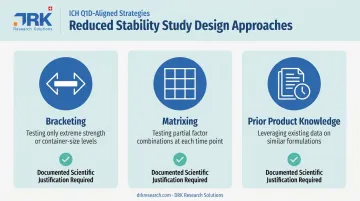
Both require documented justification and remain capable of predicting shelf life reliably.
Conclusion
Stability testing is a structured, regulatory-driven process that reveals how a drug substance or product's quality changes over time, and that data sets shelf life, storage conditions, and labeling. Understanding the mechanics behind it (protocol design, storage conditions, and data evaluation) is essential knowledge for teams making formulation, packaging, or regulatory strategy decisions.
Turning that knowledge into a compliant, market-ready program is where experienced support matters. DRK Research Solutions has spent over a decade supporting pharmaceutical and biopharmaceutical sponsors across global regulatory regions. For sponsors designing stability programs aligned with ICH Q1 expectations for their specific product and target markets, reaching out to DRK's team is a practical next step.
Frequently Asked Questions
What is a drug stability study?
A drug stability study is a series of tests evaluating how a drug substance or product's quality changes over time under specified storage conditions. Results establish shelf life and storage requirements for regulatory labeling.
What are the three types of drug stability studies?
The three primary types are long-term (real-time), intermediate, and accelerated stability studies. Each runs under different temperature and humidity conditions for different durations.
What are the ICH guidelines for drug stability studies?
ICH Q1 is the internationally harmonized standard defining stability testing requirements and data evaluation for drug substances and products. It consolidates the former Q1A through Q1F and Q5C guidelines into a single framework.
How long do stability studies typically take to complete?
Accelerated studies typically run about 6 months. Long-term studies continue for 12 months up to several years, depending on the proposed shelf life.
What is the difference between accelerated and long-term stability testing?
Accelerated testing uses elevated temperature and humidity to predict degradation quickly. Long-term testing occurs at recommended storage conditions and is required to confirm the actual shelf life.
Why is stability testing required for regulatory approval?
Regulators including the FDA, EMA, and WHO require stability data before granting approval. This data confirms a drug stays safe, effective, and consistent in quality throughout its labeled shelf life.