Impurity profiling isn't a box-ticking exercise. It directly shapes patient safety, regulatory approval timelines, batch release decisions, and a manufacturer's long-term reputation. When Hetero Labs recalled 87 lots of losartan potassium tablets in 2019 after detecting the nitrosamine NMBA, it became the third distinct nitrosamine found in ARB medicines within a year, following FDA's ongoing ARB investigation.
This article breaks down how CDMO analytical teams actually find, identify, and control these impurities, step by step.
Key Takeaways
- ICH Q3A/Q3B, Q3C, Q3D, and WHO Annex 4 legally mandate multi-technique impurity profiling
- Orthogonal methods (chromatography, mass spectrometry, spectroscopy) catch co-eluting and trace-level impurities single techniques miss
- Undetected impurities triggered major recalls in sartans, ranitidine, and metformin since 2018
- Experienced CDMO teams shorten timelines while keeping submissions audit-ready across regions
What Is Drug Impurity Profiling?
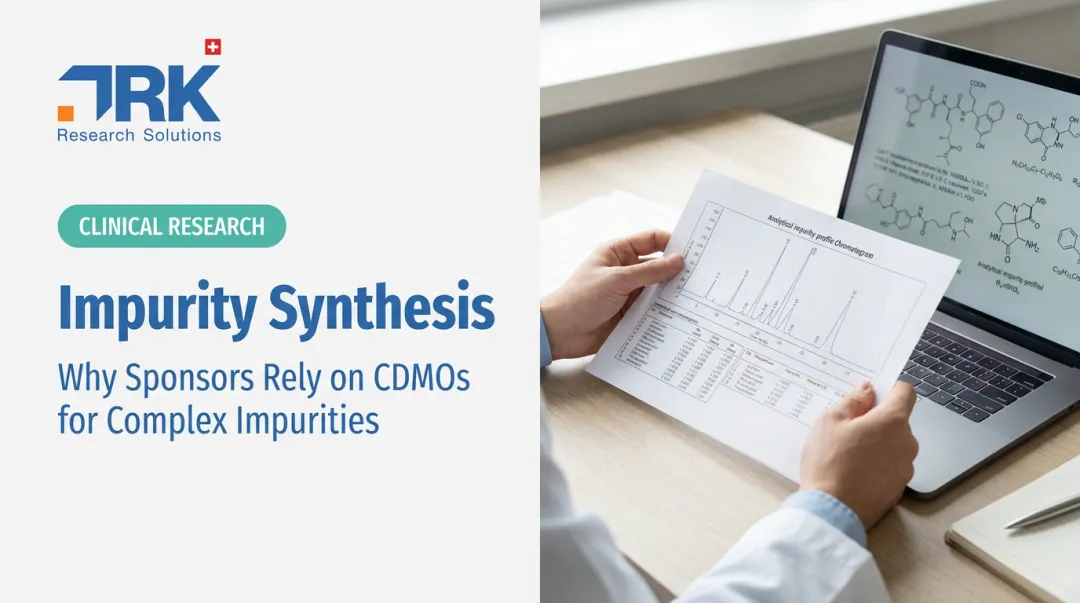
Per ICH Q3A(R2), an impurity profile is "a description of the identified and unidentified impurities present in a new drug substance," with a parallel definition covering finished products in ICH Q3B(R2). In practice, it means systematically detecting, characterizing, and quantifying everything in a sample that isn't the intended active ingredient.
The purpose goes beyond compliance. A solid impurity profile supports toxicological safety qualification, underpins the regulatory dossier, and gives manufacturing teams the data they need to control the process consistently, batch after batch.
Four Impurity Categories Every Analytical Team Tracks
- Organic impurities: starting materials, by-products, intermediates, and degradation products formed during synthesis or storage
- Inorganic impurities: heavy metals, residual catalysts, reagents, and inorganic salts left over from manufacturing
- Residual solvents: Class 1–3 solvents per ICH Q3C, ranked by toxicity tier
- Genotoxic/mutagenic impurities: substances like N-nitrosamines, plus extractables and leachables from packaging
Where It Fits in the CDMO Workflow
These four categories don't just surface once during development — they resurface at every stage of the product lifecycle. Impurity profiling isn't a one-time event; it runs through analytical development, QC release testing, ongoing stability studies, and the final regulatory submission. The governing frameworks (ICH Q3A/Q3B for substance and product impurities, plus WHO Annex 4 for quality control laboratory practices) apply at every one of these stages, not just at filing.
Why Impurity Profiling Is Critical for CDMO-Manufactured Drugs
Rigorous impurity analysis translates directly into fewer regulatory rejections and safer outcomes for patients. The 2018 sartan crisis illustrates the scale of what's at stake when it goes wrong.
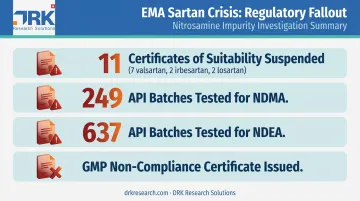
Once European regulators identified N-nitrosamines in valsartan APIs, the fallout was severe. According to the EMA's lessons-learnt report on sartan medicines:
- 11 Certificates of Suitability were suspended (7 valsartan, 2 irbesartan, 2 losartan potassium)
- 249 API batches and 2,000 medicinal-product batches were tested for NDMA by April 2019
- 637 API batches and 1,007 medicinal-product batches were tested for NDEA in the same window
- A joint GMP inspection found significant manufacturing failures at the source facility, resulting in a non-compliance certificate
This regulatory fallout illustrates why proactive impurity profiling matters long before a product reaches the market.
Core benefits of thorough impurity profiling:
- Caps toxic and genotoxic exposure, protecting patients directly
- Ensures compliance across FDA, EMA, and WHO-regulated markets simultaneously
- Supports stability studies and accurate shelf-life determination
- Identifies impurity sources early, allowing process optimization before scale-up
- Speeds up technology transfer decisions for sponsors moving toward commercial manufacturing
How Impurity Profiling Works – Techniques Used by CDMO Analytical Teams
CDMO analytical teams don't rely on a single test. They follow a structured, multi-stage workflow, and skipping method validation or rushing peak identification are among the most common (and costly) pitfalls.
Orthogonal techniques — combining chromatography, spectroscopy, and mass spectrometry — work together to catch co-eluting or low-level impurities that a single method might miss.
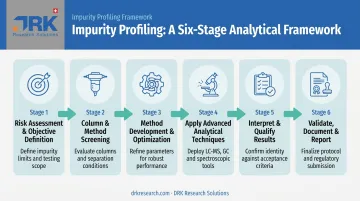
The typical workflow includes six stages:
Risk assessment & objective definition – The team defines which impurities to target based on the synthesis route, known degradation pathways, and ICH thresholds. This step drives scope accuracy and keeps the whole program aligned with regulatory expectations from day one.
Column & method screening – Analysts screen dissimilar chromatographic columns and mobile phase pH combinations to separate unknown impurities, following established RP-HPLC method development practice. The goal here is selectivity and resolution of tricky peak pairs.
Method development & optimization – Analysts fine-tune the gradient profile, organic modifier ratio, and column temperature to isolate impurities cleanly from the main API peak. Sensitivity and reproducibility are the metrics that matter most at this stage.
Apply advanced analytical techniques – This is where the instrumentation does the heavy lifting:
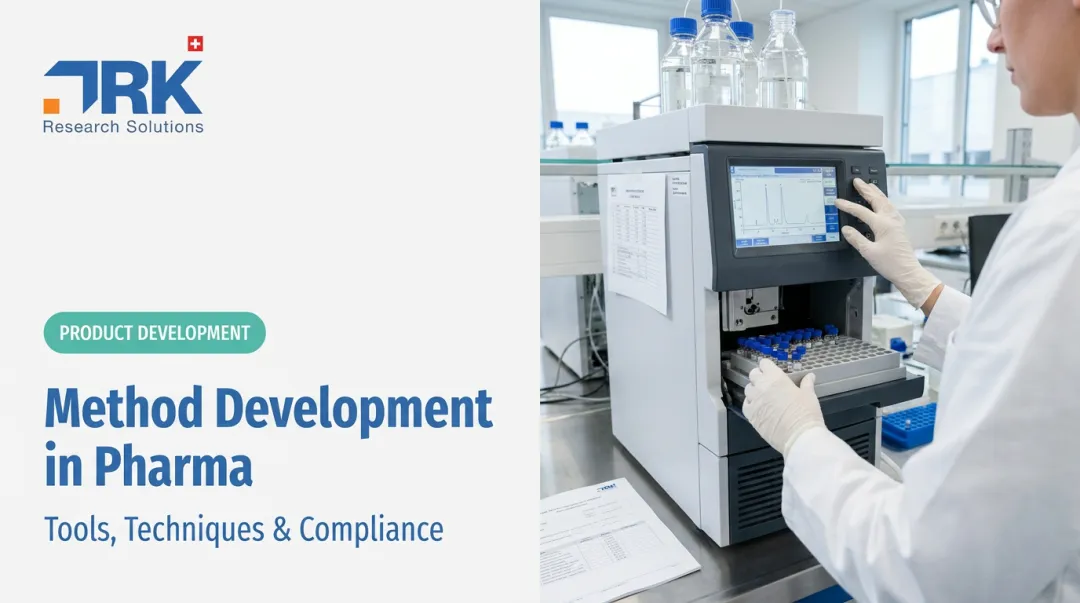
- HPLC/UHPLC for trace-level separation and quantitation
- GC and GC-MS/MS for volatile residual solvents, following the same approach FDA uses for nitrosamine testing
- LC-MS/MS and LC-HRMS for structural identification of unknown peaks
- ICP-MS for elemental impurities, per USP <233>
- NMR and IR spectroscopy for structural confirmation and polymorph investigation
Interpret & qualify results – The team compares detected impurity levels against ICH Q3A/Q3B reporting, identification, and qualification thresholds. For a drug substance dosed at 2 g/day or less, that means a 0.05% reporting threshold and a 0.15% (or 1.0 mg/day) qualification threshold, whichever is lower. This step determines toxicological risk classification and decision confidence.
Validate, document & report – The team locks the validated method, compiles batch records, and prepares regulatory-ready impurity data packages. Audit-readiness and submission speed hinge entirely on how well this final step is executed.
Impurity Profiling – Example Case Walkthrough
Picture a generic API showing an unexpected peak during routine stability testing. Here's how a competent analytical team typically handles it:
- Detection: Routine HPLC testing flags a small, unidentified peak that wasn't present at time zero
- Structural elucidation: LC-MS narrows down the likely structure, often pointing to a degradation product rather than a process impurity
- Threshold comparison: The peak's level gets checked against ICH Q3A/Q3B reporting and qualification thresholds
- Risk classification: Based on structure and level, the team decides whether toxicological qualification is needed
Common mistakes to avoid:
- Ignoring peaks that fall just below the reporting threshold, assuming they're irrelevant
- Skipping cross-checks with an orthogonal method, which can miss co-eluting impurities entirely
- Delaying toxicological assessment until late-stage development, which often forces costly rework
Once classified, the finding gets converted into something actionable, whether that's an updated specification, a revised synthesis step to eliminate the degradation pathway, or additional stability monitoring going forward. The real value lies in converting that identification into a documented, defensible decision that holds up under regulatory scrutiny.
How DRK Research Solutions Can Help
DRK Research Solutions integrates impurity profiling directly into its generics and hybrid product development services, supporting both regulated and emerging markets. Dr. Vipan Dhall, Chief Scientific Officer, leads scientific strategy across these programs, ensuring analytical rigor and regulatory alignment at every stage of development.
What working with DRK looks like in practice:
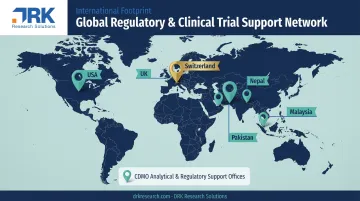
- Global regulatory reach: Localized proficiency across Europe, the Middle East, Asia, Africa, and the Americas, backed by offices in Switzerland, the UK, the USA, Pakistan, Malaysia, Nepal, and the UAE
- Faster method development: A multidisciplinary team built to move analytical validation forward without unnecessary delay
- End-to-end support: Coverage from first-in-human studies through commercial manufacturing and product launch
- Underserved market experience: A track record with LMICs, where regulatory pathways can vary significantly from region to region
For sponsors juggling multi-region filings, having one partner handle both the analytical science and the regulatory translation cuts down on rework later. This is the gap DRK's CDMO division is built to close.
Frequently Asked Questions
What is drug impurity profiling?
It's the systematic identification, characterization, and quantification of impurities present in a drug substance or product, following ICH Q3A/Q3B guidance. The result is a documented profile used for safety and regulatory decisions.
What is the purpose of creating a drug impurity profile?
It supports toxicological safety qualification, forms part of the regulatory submission, and gives manufacturing teams the data needed for consistent process control. Without it, batch release and approval timelines stall.
What are the four types of impurities?
Organic (by-products, degradation products), inorganic (heavy metals, residual catalysts), residual solvents (Class 1–3 per ICH Q3C), and genotoxic/mutagenic impurities like N-nitrosamines. Extractables and leachables from packaging are often tracked alongside these.
What are the WHO and ICH guidelines for impurity profiling?
ICH Q3A and Q3B set reporting, identification, and qualification thresholds for drug substances and products. WHO Annex 4 covers good practices for pharmaceutical quality control laboratories performing this testing.
What analytical techniques are most commonly used to detect impurities?
HPLC/UHPLC and GC handle separation and quantitation, LC-MS/MS identifies unknown structures, ICP-MS detects elemental impurities, and NMR or IR spectroscopy confirms structural details. Teams typically combine several of these for reliable results.
How can a CDMO help with impurity profiling during drug development?
A CDMO brings validated methods, regulatory-aligned documentation, and multi-region compliance expertise that many in-house teams don't have readily available. That combination shortens timelines and reduces the risk of findings surfacing late in development.