
This guide is written for emerging sponsors: small and mid-size pharma, biopharma, and life science companies preparing for their first Investigational New Drug (IND)-enabled trial in the US. We'll walk through the step-by-step planning process, the factors that determine success, common first-time mistakes, and how to evaluate a research partner.
Key Takeaways
- Begin with preclinical data and protocol design well before enrollment opens.
- Tight budgets make vendor and CRO selection a high-stakes decision for emerging sponsors.
- Map FDA/IRB pathways and trial phases early to prevent costly, avoidable delays.
- Phase site selection, supplies, and data systems to cut the risk of trial failure.
What Does It Mean to "Plan" a Clinical Trial?
Clinical trial planning is the pre-study process that covers protocol development, regulatory submissions, site and vendor selection, and operational setup. It's everything that happens before the first patient signs a consent form.
The goal is straightforward to state, harder to execute: build a study that's scientifically valid, ethically sound, and regulatory-compliant, and that can enroll and retain participants on time and within budget.
Planning and management are separate phases:
- Trial planning covers pre-study startup: protocol design, IND/IRB submission, and site activation
- Trial management covers what follows first patient in: monitoring, data cleaning, and safety reporting during the study
Sponsors who blur this line often underestimate how much work needs to happen before patient one.
Why Rigorous Planning Is Critical for Emerging Sponsors
Large pharma companies have dedicated regulatory affairs departments, in-house biostatisticians, and established CRO relationships. Emerging sponsors typically don't. That gap makes every planning misstep more expensive: there's no internal backstop to catch it. The data on delays is sobering. A 2023 analysis found that among completed trials studied, the median delay was 12.2 months, or 66.7% longer than originally planned (Shadbolt et al., 2023). Recruitment research also shows that a majority of trials miss their initial enrollment targets and timelines. What commonly goes wrong without a structured plan:
- Budget overruns from unplanned protocol amendments
- IRB rejections due to incomplete or inconsistent documentation
- Slow enrollment from poor site or population fit
- Data integrity issues from rushed system setup Thorough planning is an explicit FDA/GCP expectation under ICH E6(R2) guidance, which requires scientifically sound design and documented oversight before a study begins.
The Step-by-Step Clinical Trial Planning Process
Trial planning flows in a logical sequence: scientific rationale, protocol design, regulatory approval, site activation, and supply readiness, all before the first patient enrolls.

Step 1: Define the Research Question and Review Preclinical Data
Before anything else, confirm your preclinical safety and toxicology data supports a safe starting dose and a credible study rationale. Skipping this validation is one of the fastest ways to trigger an FDA clinical hold later.
Step 2: Develop the Clinical Trial Protocol
Your protocol needs clear objectives, a defined study design, a statistical analysis plan, and a safety monitoring framework. Every element must align with GCP and ICH standards. Reviewers will check.
Step 3: Prepare and Submit Regulatory Applications
An IND submission under 21 CFR Part 312 is required before most drug trials can begin in the US (devices follow the IDE pathway instead). In parallel, you'll need Institutional Review Board or Ethics Committee approval. These tracks run simultaneously, not sequentially. Plan for both.
Step 4: Select Sites, Investigators, and Vendors
Look for:
- Investigators with prior GCP compliance history
- Sites with demonstrated access to your target patient population
- Experienced staff who've run similar protocols before
- CRO and lab partners with relevant therapeutic expertise
Step 5: Establish Data Management and Safety Monitoring Systems
Set up an EDC system compliant with 21 CFR Part 11 for electronic records and signatures. Build out safety monitoring plans and reporting workflows before enrollment starts, not after the first adverse event.
Step 6: Plan Clinical Supply, Budget, and Timeline
Forecast investigational product demand, sort out packaging and labeling requirements, and build a budget with realistic contingency built in. This is where many first-time sponsors underestimate costs by a wide margin.
Step 7: Conduct Site Initiation and Activate the Study
Hold investigator meetings, collect essential regulatory documents, train site staff, and confirm each site is truly ready (not just scheduled) before opening enrollment.

Key Factors That Affect Trial Planning Success
Several variables determine whether your planning phase runs smoothly or drags on for months:
- Preclinical/PK data quality: Incomplete packages force protocol rework and push timelines back
- Regulatory complexity: Shifts by drug class, indication, and US-only versus multi-region strategy
- Site and patient availability: Hardest for rare diseases and underserved populations
- Budget and vendor bandwidth: A frequent ceiling for emerging sponsors before the science is
- Data infrastructure: 21 CFR Part 11 and GCP controls are difficult to retrofit once systems are live
Common Planning Mistakes First-Time Sponsors Make
Three mistakes show up again and again in trials run by first-time sponsors:
- Underestimating IND/IRB timelines. Documentation takes longer than expected, and delays here cascade through the entire schedule.
- Choosing vendors on price alone. A cheaper CRO without therapeutic-area experience often costs more in rework and delays.
- Skipping contingency planning. Budgets and timelines without buffer for amendments or slow enrollment tend to break under real-world pressure.

Choosing the Right CRO Partner for Your First Trial
For a sponsor without an in-house regulatory department or established site network, a full-service CRO can close that gap: regulatory strategy, clinical operations, and data management.
Global reach paired with local regulatory knowledge matters most when your first trial crosses borders. DRK Research Solutions, active across Europe, the Middle East, Asia, Africa, and the Americas, works with emerging sponsors navigating multi-regional requirements while maintaining GxP and ethical standards.
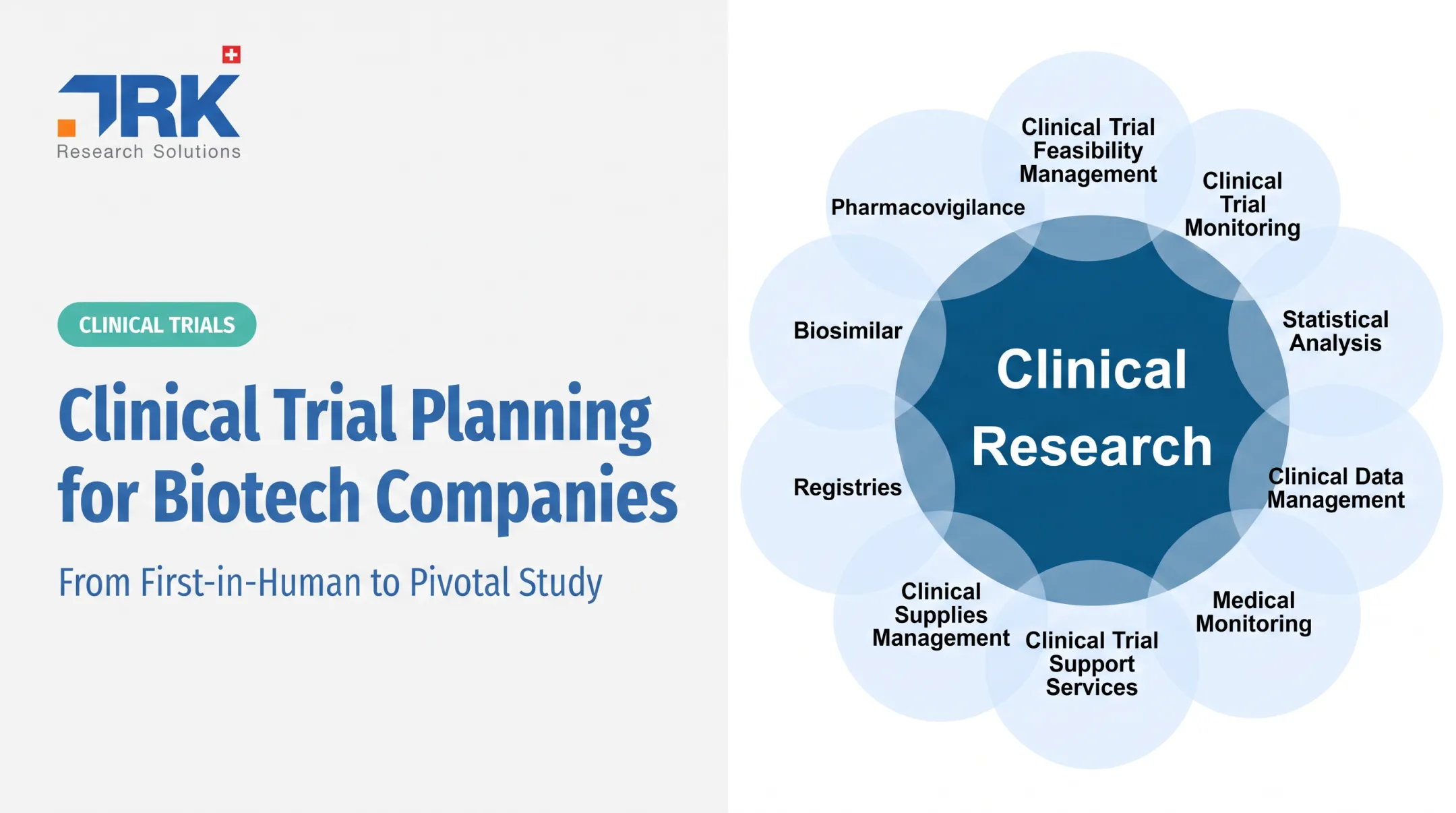
End-to-end support, from protocol design and site feasibility through data management and study closeout, can shorten development timelines when you lack that infrastructure in-house. That includes:
- Regulatory documentation and submission support
- Site identification, feasibility, and monitoring
- Full-lifecycle data management, from eCRF programming to database lock
- Clinical supply management, including storage and labeling

When evaluating a CRO partner, look past the sales pitch. Ask about:
- Track record with your specific therapeutic area
- Experience supporting patient-centric, compliant trial execution
- Ability to scale support as your program grows into later phases
Frequently Asked Questions
What are the 5 stages of clinical trials?
Preclinical testing establishes basic safety in the lab and animal models. Phase I tests safety in humans, Phase II evaluates whether it works, Phase III compares it with standard care, and Phase IV monitors it after approval.
What are the 13 principles of Good Clinical Practice (GCP)?
ICH E6 principles cover ethics, informed consent, IRB/ethics committee oversight, scientific soundness, protocol adherence, investigational product control, and data integrity. See the ICH E6(R2) guidance for the complete list.
How long does it take to plan a first clinical trial?
Study startup typically averages 6–7 months, though timelines vary widely. That phase can account for up to 30% of total trial duration, depending on the regulatory pathway and site readiness.
How much does it cost to start a clinical trial?
Costs depend heavily on phase, indication, and complexity. Primary drivers include site fees, CRO costs, lab services, and patient recruitment. Phase I studies alone can range from roughly $1.4 million to over $6 million by therapeutic area.
Do I need an IND before starting a clinical trial in the US?
Generally, yes. Under 21 CFR Part 312, an IND must be submitted and in effect before testing an investigational drug or biologic in humans, with limited exemptions.
What is the difference between a CRO and a sponsor?
The sponsor holds ultimate legal and regulatory responsibility for the trial. A CRO is contracted to perform some or all trial-related functions, but that delegation doesn't shift accountability away from the sponsor.