Introduction
The global pharmaceutical CDMO market hit $166.0 billion in 2025 and is projected to grow at a 7.4% CAGR through 2033, according to a 2025 industry report from Grand View Research. That growth means more sponsor companies than ever are handing production of their drug products to third parties.
Yet many sign contract manufacturing agreements (CMAs) without fully grasping the clauses that protect their intellectual property, quality standards, and supply continuity. The result: costly disputes, stalled launches, and IP fights that could have been avoided with better drafting.
This article breaks down the agreement types you'll encounter, the clauses no CMA should skip, what regulators expect from quality agreements, and practical steps for negotiating and managing these relationships.
Key Takeaways
- The global CDMO market hit $166.0B in 2025, raising the stakes on every outsourcing deal.
- CMAs typically involve a family of documents, not one master contract.
- Quality agreements must stay separate from commercial terms per FDA guidance.
- IP, liability, and continuity clauses vary significantly by drug modality.
- Neither party can delegate away its statutory cGMP responsibility.
What Is a Pharma Contract Manufacturing Agreement, and Why Does It Matter?
A pharma contract manufacturing agreement (CMA) is the legal document governing the relationship where a pharmaceutical or biopharma company outsources production of its drug product to a third-party manufacturer. It covers specifications, financial terms, responsibilities, and the operational boundaries between sponsor and manufacturer.
Companies outsource for several concrete reasons:
- Cost and scale efficiency — avoiding capital expenditure on facilities they'd otherwise underuse
- Access to specialized technology, particularly for biologics, cell, and gene therapies that require equipment most sponsors don't own
- Geographic and regulatory access, letting a product reach new markets faster
- Freeing internal resources to focus on R&D and commercialization rather than plant operations
CMO vs. CDMO: Understanding the Distinction
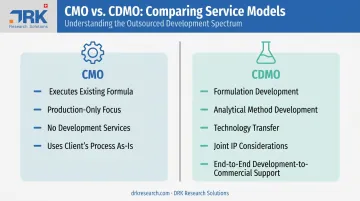
A CMO (contract manufacturing organization) focuses purely on production, executing a client's formula and process as handed to them. A CDMO (contract development and manufacturing organization) goes further, adding development services like formulation work, analytical method development, and technology transfer into the same relationship.
This distinction matters because it changes what belongs in the agreement. A CDMO contract needs development milestones, defined deliverables for each development phase, and clear terms on who owns IP generated jointly during that work.
DRK Research Solutions illustrates this well. Its CDMO offering, introduced in 2022, focuses on generics and hybrid product development for regulated markets, including formulation design, analytical method development, technology transfer, and eCTD dossier preparation. Pairing that with an established CRO business built since 2016 means a sponsor can move from clinical development straight through to commercial manufacturing support without switching partners mid-program.
Types of Contracts You'll Encounter in Pharma Contract Manufacturing
A single outsourcing relationship is rarely governed by one document. It typically involves a family of interconnected agreements, each covering a different slice of the relationship.
Supply Agreements
Supply agreements grant exclusive or semi-exclusive rights to sell product to buyers. They typically address quality expectations at a high level, shipping terms, and how disputes get resolved between commercial partners.
Manufacturing Agreements
These define the actual production scope: what gets made, in what quantities, and under whose responsibility. A well-drafted manufacturing agreement lets sponsors stay focused on drug development and marketing while the manufacturer owns execution.
Quality Agreements
Quality agreements document CGMP-related roles and responsibilities separately from commercial terms like pricing or liability. FDA's 2016 guidance on quality agreements makes this separation explicit, a requirement we'll unpack in detail below.
Confidentiality, Licensing & IP Agreements
Given that drug development timelines often stretch 10 to 15 years, NDAs, licensing terms, and IP-ownership provisions carry real weight. Licensing clauses define how each party may use the other's proprietary technology or manufacturing know-how. These agreements must also distinguish:
- Background IP — what each party owned before the relationship began
- Foreground IP — anything newly generated during the collaboration
Technology Transfer Agreements
These govern the transfer of process knowledge, formulation data, and analytical methods from sponsor to manufacturer, or between manufacturing sites, across development phases. They typically define a project lead, a cross-functional subject-matter-expert team, and documented gap assessments.
Essential Clauses Every Pharma Contract Manufacturing Agreement Should Include
Regardless of which family of documents you're using, several clauses show up repeatedly as the difference between a smooth partnership and a legal headache.
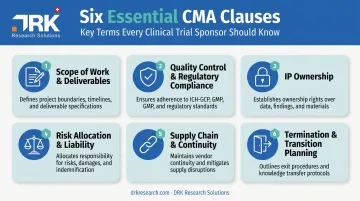
Scope of Work & Deliverables Precisely define each production stage, API synthesis, formulation, clinical or commercial batches, packaging, and the exact quantities involved. Vague scope language is the single biggest driver of shortage and surplus disputes.
Quality Control & Regulatory Compliance Alignment with GMP, FDA, and EMA standards isn't optional. The consequences of getting this wrong are severe. FDA's 2021 inspection of a contract facility in Baltimore followed serious contamination findings. According to a congressional report cited by Fierce Pharma, the incident led to the destruction of material equivalent to nearly 400 million vaccine doses.
Intellectual Property Ownership Separate background IP from foreground IP clearly, and include trade secret protections that survive contract termination.
Risk Allocation & Liability Cost overruns, product liability, and force majeure events, such as pandemics or supply shocks, need explicit allocation between parties. Don't leave this to implication.
Supply Chain & Continuity Provisions Address raw material sourcing, transport and storage conditions, and backup manufacturer clauses. A single-source dependency without a contingency plan is a self-inflicted risk.
Termination & Transition Planning Include clear notice periods, technology transfer support obligations, and wind-down responsibilities if either party exits. Agreements that skip this leave sponsors scrambling if a manufacturer relationship sours.
Quality Agreements: What Regulators Expect
FDA's 2016 guidance on quality agreements is the reference point most sponsors and manufacturers work from. It draws a hard line: quality agreements must stay separate from commercial terms like pricing, confidentiality, and liability. Those belong in the supply or master services agreement instead.
According to FDA's 2016 guidance, a quality agreement should cover:
- Purpose and scope — the nature and extent of the contracted manufacturing services
- Definitions — shared terminology so owner and contract facility interpret obligations the same way
- Dispute resolution process — how quality disagreements get escalated and resolved
- Manufacturing activity documentation — allocation of quality-unit responsibilities, facilities, materials management, and lab controls
- Change control procedures — who validates changes before implementation, and how they're communicated
These five components define what the agreement should contain, but the document has real limits too. A quality agreement cannot delegate away statutory CGMP responsibility, and both the product owner and the contract facility remain independently liable to regulators no matter what the contract says internally.
Disputes over equipment maintenance schedules or calibration records are a common real-world flashpoint, precisely because both parties assume the other is covering it. Spell out ownership explicitly, or expect this to surface during an inspection.
How Contract Terms Vary by Product Modality
Not every CMA looks the same, as the right clauses depend heavily on what you're actually manufacturing.
Small Molecules
These agreements lean heavily on IP and patent enforcement, since small-molecule chemistry is more susceptible to reverse engineering. Confidentiality clauses need real teeth, not boilerplate language.
Biologics
Because biologic manufacturing is sensitive to "process drift," where subtle process changes can alter product purity or structure, agreements must give the sponsor final approval rights over any manufacturing process change. The sponsor should also require comparability assessments automatically whenever a change is proposed.
Personalized Cell & Gene Therapies
Patient-specific biological material raises the stakes further, so these agreements need to include:
- Documented chain-of-identity protocols from collection through administration
- Chain-of-custody tracking at every handoff point
- Patient data confidentiality clauses that meet privacy regulations across every jurisdiction involved
Best Practices for Negotiating and Managing CMAs
Getting the contract right on paper is only half the job. Managing it well over years of production is where most value gets protected or lost.
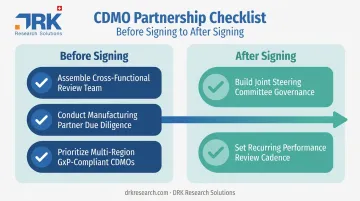
Before signing:
- Assemble a cross-functional review team, legal, regulatory, quality, and supply chain, before finalizing any agreement. Gaps that look minor to one department often look critical to another.
- Conduct due diligence on the manufacturing partner, covering facility inspection history, financial health, and track record with similar products.
- Prioritize CDMOs with GxP-compliant operations across multiple regulatory regions, spanning frameworks like EU GMP, US FDA, MHRA, WHO PQ, and PIC/S, since multi-region compliance history lowers onboarding risk.
Sponsors without in-house regulatory bandwidth often bring in CROs with cross-regional compliance experience, such as DRK Research Solutions, to help vet these manufacturing partners before a CMA is signed.
After signing:
- Build ongoing governance, such as a joint steering committee, to track KPIs, manage change requests, and keep communication transparent throughout the contract's life.
- Set a recurring cadence for reviewing performance data rather than waiting for an annual audit to surface problems.
Frequently Asked Questions
What is the difference between a CMO and a CDMO agreement?
A CMO agreement covers production only, based on a sponsor's existing formula and process. A CDMO agreement also includes development services, such as formulation work and technology transfer, making it broader in scope.
What should a pharma quality agreement include, and how is it different from a supply agreement?
A quality agreement covers CGMP roles, dispute resolution, and change control. A supply agreement covers commercial terms like pricing, delivery schedules, and liability. Per FDA guidance, the two should remain separate documents.
Who typically owns the intellectual property developed during contract manufacturing?
Ownership depends entirely on the agreement's IP clause. Background IP owned before the relationship stays with its original owner, while foreground IP developed jointly needs explicit allocation terms.
What happens if a contract manufacturer fails a GMP inspection?
Consequences can include product holds, recalls, and regulatory action against the facility. Both the product owner and the manufacturer share liability, since CGMP responsibility can't be delegated away.
How long does a typical pharma contract manufacturing agreement last?
Terms vary widely, but 3 to 5 years with renewal options is common. Complexity of the product and commercial volume commitments both influence the length.
How do sponsor companies choose the right CDMO partner for generics or specialty products?
Key criteria include regulatory track record across relevant markets, technical expertise in the specific modality, global manufacturing reach, and transparent governance once the partnership is active.