Introduction
Getting a therapeutic candidate from a lab bench to a pharmacy shelf follows a structured, multi-stage journey. It moves through molecule discovery, formulation, testing, regulatory approval, and commercial manufacturing before a physician ever writes a prescription.
For pharmaceutical and biopharmaceutical sponsors, overlooking any phase creates real risk: regulatory delays, patient safety gaps, and stalled returns on investment.
The often-cited "$2.6 billion, 10 years" figure from Tufts Center for the Study of Drug Development sums up drug development costs in shorthand. Few explain what actually happens inside those years, phase by phase.
This article breaks down each stage, the factors that stretch or compress timelines, and where partners like CROs and CDMOs fit into the picture.
Key Takeaways
- Drug development spans five connected phases: discovery, preclinical research, clinical trials, regulatory review, and manufacturing/monitoring
- Each phase reduces risk while building the safety and efficacy data regulators demand
- Clinical development alone spans a median of 8.3 years, per Clinical Pharmacology & Therapeutics research
- Compound complexity, formulation difficulty, and regulatory pathway choices shift timelines
- An experienced CRO/CDMO partner helps sponsors manage complexity without losing momentum
What Is the Drug Product Development Process?
The drug product development process is the end-to-end scientific, clinical, and regulatory pathway that turns a candidate molecule into an approved, manufacturable therapy. The outcome it's built to produce: a safe, effective, and consistently manufacturable product with a demonstrated benefit-risk profile.
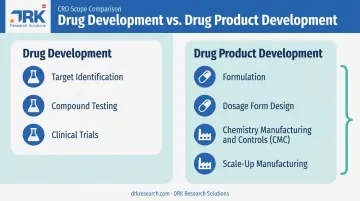
The two terms are often used interchangeably, but they mean different things:
| Term | Scope |
|---|---|
| Drug development | Discovery-to-approval science: identifying targets, testing compounds, running trials |
| Drug product development | Extends further to include formulation, dosage form design, and Chemistry, Manufacturing, and Controls (CMC) work needed to produce the medicine at scale |
This isn't a process any single company gets to define on its own terms. The FDA, EMA, and other national authorities govern it, meaning every sponsor works within the same regulatory boundaries regardless of size or geography.
Why the Drug Product Development Process Matters in Pharma
Regulators require documented proof of safety and efficacy before any product reaches a patient. That single requirement is why the phased structure exists at all.
The industry demands three things this process is designed to deliver:
- Manufacturing consistency — every batch performs the same way, every time
- Patient safety — risks are identified and managed before wide exposure
- Reliable clinical outcomes — data holds up under regulatory and real-world scrutiny
Skip the rigor, and problems surface later, when they're far more expensive to fix. Formulation instability discovered post-launch. Safety signals missed because a trial wasn't powered to catch them. Scale-up failures that stall a product after approval, when a sponsor assumed the hard part was over.
This rigor serves two purposes: it satisfies a regulatory mandate from agencies like the FDA and EMA, and it protects what's often a nine- or ten-figure investment before it's too late to course-correct.
The Phases of Drug Product Development Process (Step-by-Step Breakdown)
Each phase builds directly on data from the one before it. Candidates get narrowed. Confidence in safety, efficacy, and manufacturability grows with each stage.
What goes in: a validated target or compound. What comes out at the end: regulatory-approved labeling, locked manufacturing specifications, and post-market safety commitments.
Phase 1: Discovery and Development
Researchers start by identifying a disease-relevant biological target, then screen or design compounds that interact with it. Early assessments look at absorption, mechanism of action, and how the compound behaves alongside other substances.
The attrition here is steep. A widely cited industry funnel shows that roughly 10,000 compounds get screened for every one that reaches approval — with only about 250 advancing to preclinical testing and just 5 making it into clinical trials, according to a 2020 peer-reviewed review on drug discovery.
That's an illustrative industry estimate, not a fixed rule, but it captures how much filtering happens before a candidate is even considered promising.
Phase 2: Preclinical Research and Formulation Development
This is where in vitro and in vivo testing evaluates toxicity, pharmacokinetics, and pharmacodynamics, all conducted under Good Laboratory Practice (GLP) standards. In parallel, early formulation work begins: dosage form selection, stability testing, and bioavailability assessment.
This stage answers one core question: is the compound stable and deliverable enough to justify moving into human trials?
Formulation teams typically optimize across three dimensions:
- Manufacturability — can it be reliably produced at scale later on
- Stability — will it hold up through its intended shelf life
- Regulatory acceptance — does the formulation align with global regulatory expectations from the start
Dissolution testing and bioavailability enhancement work fall here too, particularly for complex molecules that don't dissolve or absorb predictably.
Phase 3: Clinical Trials (Phase I–III)
Clinical testing unfolds across three distinct stages:
- Phase I — Small studies, usually in healthy volunteers, focused purely on safety and dosing tolerance
- Phase II — Larger patient groups testing efficacy and refining optimal dosing
- Phase III — Large-scale, statistically powered trials confirming efficacy and monitoring for less common side effects
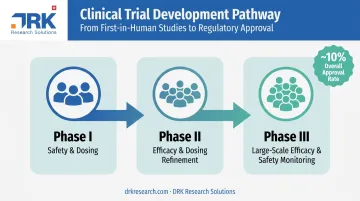
The odds of making it all the way through are sobering. Only about 7.9% of candidates that enter Phase I ever reach approval, according to a 2021 BIO, QLS, and Informa analysis covering nearly 9,700 development programs between 2011 and 2020.
Site selection quality plays a bigger role in delays than most sponsors expect. Poor site selection is consistently cited as one of the leading causes of clinical trial timeline slippage, which is exactly why feasibility assessment happens before a single patient is enrolled.
Phase 4: Regulatory Review and Approval
Once Phase III data is in hand, sponsors submit a New Drug Application (NDA), Biologics License Application (BLA), or Marketing Authorization Application (MAA) depending on the product type and target market. A multi-disciplinary regulatory team then reviews everything: clinical data, manufacturing documentation, proposed labeling.
Review timelines vary by pathway:
| Pathway | Typical Timeline | Notes |
|---|---|---|
| Standard FDA review | 10 months | From 60-day filing date |
| Priority review | 6 months | For serious conditions with unmet need |
| EMA standard | Up to 210 active days | Excludes applicant clock stops |
| EMA accelerated | ~150 days | For major public-health interest products |
Fast Track, Breakthrough Therapy, and Accelerated Approval designations can speed things up further, but they don't shorten the science required before submission.
Phase 5: Manufacturing Scale-Up and Post-Market Monitoring
Approval isn't the finish line. Products now need to move from small clinical batches to full commercial-scale manufacturing under Good Manufacturing Practice (GMP) conditions.
This transition introduces real technical risk. A formulation that performed perfectly at lab scale doesn't always behave the same way in a commercial reactor or fill line. Technology transfer — detailed process documentation, scale-up studies, on-site support — exists specifically to catch and correct these gaps before they become supply problems.
Once launched, pharmacovigilance systems like the FDA's Adverse Event Monitoring System (built on the FAERS database) and the EU's EudraVigilance continue tracking safety signals from real-world use.
This is exactly where product development expertise adds value. DRK Research Solutions supports sponsors through technology transfer, formulation development, and eCTD dossier preparation, helping bridge the gap between "approved" and "actually available to patients."
Key Factors That Influence Each Phase
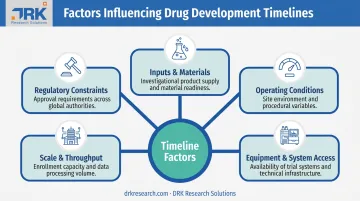
Timelines rarely move in a straight line. A handful of variables consistently determine whether a phase runs on schedule or drags:
- Inputs and materials: compound stability, raw material sourcing, and API quality directly shape preclinical and formulation outcomes
- Operating conditions: therapeutic area, patient population size, and disease complexity all change trial design and length
- Equipment and system access: availability of specialized labs, animal models, or GMP-certified manufacturing capacity can accelerate or completely bottleneck a phase
- Scale and throughput: moving from small clinical batches to commercial production introduces technology-transfer and reproducibility risk that's easy to underestimate
- Regulatory constraints: differing requirements across the FDA, EMA, and emerging-market authorities can extend timelines significantly, especially for multi-regional trials targeting LMICs
That last point matters more than sponsors often assume. WHO Prequalification and PIC/S compliance frequently determine whether a product gets accepted into low- and middle-income country markets at all, regardless of FDA or EMA approval status.
DRK Research Solutions builds WHO PQ and PIC/S requirements into project planning from day one for this reason, particularly on multi-regional trials serving LMICs.
Common Challenges and Misconceptions in Drug Product Development
A few misunderstandings show up again and again, usually with expensive consequences:
- Development vs. product development: These aren't interchangeable. The former covers discovery science; the latter demands CMC planning, formulation work, and manufacturability testing that discovery-stage teams often overlook until it's too late.
- Trial success doesn't guarantee approval: Sponsors sometimes treat a positive Phase III readout as the finish line. Manufacturing documentation, labeling negotiations, and post-market commitments still stand between trial data and a market-ready product.
- Approval isn't launch readiness: Scale-up validation and supply chain qualification often happen after regulatory approval, not before. A sponsor can hold an approved product and still be months away from actually shipping it to pharmacies.
Conclusion
Drug product development is a five-phase, risk-reducing pathway: discovery, preclinical research, clinical trials, regulatory review, and manufacturing with post-market monitoring. Each phase exists to build the evidence the next one requires.
Understanding this structure lets sponsors plan realistic budgets, timelines, and regulatory strategy instead of treating development as an opaque black box.
That clarity matters most when choosing a development partner. Partnering with an experienced global CRO like DRK Research Solutions, with capabilities spanning early-phase clinical trials through regulatory submission and product development, gives sponsors a single accountable partner across that journey. This partnership helps get innovative therapies to the patients waiting for them.
Frequently Asked Questions
What are the 5 main steps of developing a drug?
The five core phases are discovery and development, preclinical research, clinical trials, regulatory review, and manufacturing with post-market monitoring. Each phase builds evidence the next one depends on.
What are the 5 R's of drug development?
The 5 R's framework (Right target, Right tissue, Right safety, Right patient, Right commercial potential) helps teams assess candidate viability before major investment. It originated at AstraZeneca and has since been adopted more broadly across the industry.
How long does the drug product development process take?
It typically spans a decade or more, though clinical development alone has a median of 8.3 years from first-in-human study to approval. Total timelines vary by therapeutic complexity and regulatory pathway chosen.
What is the difference between drug discovery and drug product development?
Drug discovery focuses on finding and validating a candidate compound. Drug product development covers everything after: formulation, testing, manufacturing process design, and the regulatory approval of that specific compound.
What role does a CRO play in drug product development?
A CRO supports formulation development, analytical method development, and technology transfer alongside regulatory documentation across multiple phases. This spans lab-scale formulation work through eCTD dossier preparation.
What is the success rate of a drug moving from discovery to approval?
From initial screening to approval, success rates run around 0.01%, based on illustrative industry funnels. Once a candidate reaches Phase I trials specifically, the likelihood of approval rises to roughly 7.9%.