This explanation is written for pharmaceutical and biopharmaceutical companies, CMC and quality teams, and sponsors evaluating the jump from clinical development to market launch. Getting this transition right affects regulatory compliance, budget, and how quickly patients access treatment.
"Commercial manufacturing" gets mentioned constantly in industry conversations, yet the operational, step-by-step reality behind it is often poorly understood. This article breaks down what commercial manufacturing actually is, how scale-up works, what factors influence it, the pitfalls that trip up sponsors, and when bringing in a CDMO partner makes sense.
Key Takeaways
- Commercial manufacturing means GMP-validated production for market distribution, not clinical trial batches
- Scale-up requires technology transfer, process validation, and facility approval before distribution
- Success hinges on raw material sourcing, equipment capacity, batch consistency, and regulations
- Underestimating validation timelines and confusing manufacturing with market supply are common pitfalls
- An experienced CDMO partner cuts cost, risk, and time-to-market for sponsors lacking infrastructure
What Is Commercial Drug Manufacturing?
Commercial drug manufacturing is the large-scale, validated production of an approved drug intended for market distribution, carried out after successful clinical trials and regulatory approval. It's the step where a formulation stops being a research project and starts being a product.
The goal itself is straightforward: consistent, reproducible batches that meet predefined quality specifications every single time, at a volume that can reliably meet patient demand. A single bad batch also becomes a supply problem, leaving patients waiting on medication they need.
Clinical vs. Commercial Manufacturing: What's the Difference?
Clinical trial material and commercial product may share a formula, but the manufacturing philosophy behind each is completely different.
| Factor | Clinical Manufacturing | Commercial Manufacturing |
|---|---|---|
| Purpose | Supply trial subjects | Supply the market |
| Batch size | Small, variable | Large, standardized |
| Flexibility | Adaptable to protocol changes | Locked in through validation |
| Regulatory oversight | Tailored to development phase | Full CGMP, ongoing |
Clinical manufacturing prioritizes adaptability, since trial protocols evolve and formulations may shift between phases. Commercial manufacturing locks in a standardized, reproducible process through formal validation, and any change to it triggers a regulatory filing.
The Scale-Up Process: From Clinical Trials to Commercial Production
Scale-up is the structured process of moving a drug's manufacturing method from small clinical batches to a validated commercial-scale process, without altering the critical quality attributes that made the drug approvable in the first place.
This transition typically gets triggered as a drug approaches late-stage trials or receives regulatory approval. It's a one-time event for each product and site, but a high-stakes one. Get it wrong, and launch gets delayed by months.
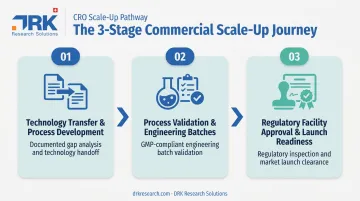
Step 1: Technology Transfer & Process Development
Technology transfer is the formal handoff of manufacturing knowledge, equipment specifications, and process parameters from R&D or clinical sites to the commercial facility.
The World Health Organization describes it as a controlled, logical procedure for moving process, documentation, and technical expertise between sites. This requires a documented quality-risk assessment and gap analysis before the receiving site takes over (WHO Technology Transfer Guidelines, TRS 961 Annex 7).
For sponsors expanding into new markets, this handoff gets complicated fast when receiving sites sit across different countries and regulatory frameworks. CROs with established technology transfer and product development expertise, including DRK Research Solutions, help simplify this process through detailed documentation, scale-up study design, and regulatory dossier support for manufacturing partners.
Step 2: Process Validation & Engineering Batches
Engineering runs and formal process validation batches confirm the process actually works at full commercial volume, not just at lab or pilot scale.
The FDA frames this as a three-stage lifecycle:
- Process design based on development knowledge
- Process qualification of facility and equipment
- Continued process verification once commercial manufacturing is underway
Regulators don't prescribe a fixed number of validation batches. The batch count must be scientifically justified based on process variability and demonstrated control, not a rule-of-thumb "three batches and done" approach.
Step 3: Regulatory Facility Approval & Launch Readiness
Manufacturing sites must pass GMP inspections by the relevant authority (FDA, EMA, WHO-Prequalification, or a national regulator) before commercial distribution can legally begin. FDA's preapproval inspection framework checks four things:
- Commercial readiness
- Conformance to the application
- Data integrity
- Quality commitment
Any post-approval changes, like adding a new manufacturing site, typically require separate filings. In the EU, a new finished-product site can trigger a Type II variation, adding weeks or months to the timeline if not planned in advance.
Where Commercial Manufacturing Fits in the Product Lifecycle
Commercial manufacturing shows up at several points across a drug's life: initial market launch, line extensions, technology transfers to new manufacturing sites, and capacity expansions when demand grows. Unlike a one-time clinical batch, it's a recurring, demand-driven activity, triggered by sales forecasts, new market entries, or supply agreements.
Several factors determine how smoothly that recurring activity runs:
- Raw material and API sourcing quality — qualified backup suppliers prevent shortages when a primary source falters
- Facility and equipment capacity — validated equipment and cleanroom classifications directly affect throughput
- Batch size, scale, and frequency — must align with global demand forecasts, not just current orders
- Market-specific regulatory constraints — FDA, EMA, and WHO-Prequalification each carry distinct requirements, especially for access in low- and middle-income countries
- Supply chain and cold-chain logistics — reliable, on-time market supply depends on this as much as the manufacturing itself
Sourcing risk deserves particular attention. A 2019 FDA analysis of drug shortages found that 40% of generic drug markets had only a single manufacturer, with a median of just two manufacturers per market. That's a fragile setup when one facility hits a snag.
The same analysis noted most facilities operate above 80% capacity, which limits how fast production can ramp up without new equipment or qualified staff.
Common Challenges, Misconceptions & the Real Cost of Commercialization
The biggest misconception in commercial manufacturing? Assuming a process proven in clinical trials can move directly to commercial scale without further validation. It can't. Regulators require the commercial process to be independently validated at full scale, using the qualified commercial facility, trained personnel, and actual commercial equipment—not extrapolated data from smaller batches.
There's also frequent confusion between "manufacturing" and "market supply." Manufacturing is the production step. Market supply is everything downstream: distribution, warehousing, and demand planning. A sponsor can have flawless manufacturing and still face stockouts if the supply chain behind it isn't built out.
What Drives the Cost
Commercialization costs vary too widely for a single benchmark number to be useful, but the main cost drivers are consistent across products:
- Facility build-out or retrofitting to meet commercial-scale requirements
- Validation batches at full commercial volume, including analytical testing and stability work
- Regulatory filings across each target market
- Technology transfer activities and documentation
- Quality systems capable of supporting ongoing commercial oversight
Sponsors frequently underestimate the time and cost tied to process validation and facility approval. McKinsey's analysis of sterile dosage-form technology transfers found timelines ranging from 18 to over 30 months (McKinsey, Why Tech Transfer May Be Critical to Beating COVID-19). Transfers to external parties averaged nearly six months longer than internal ones.
That's a long runway to budget for, and it's one of the leading causes of launch delays.
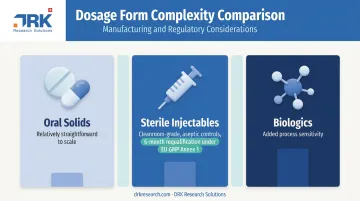
Dosage form matters enormously here too. Oral solids are relatively straightforward to scale. Sterile injectables demand cleanroom-grade environments, aseptic controls, and requalification every six months under EU GMP Annex 1. Biologics add their own layer of process sensitivity. Teams that budget for an oral solid launch and then pivot to a sterile product often get blindsided by the gap.
When Building In-House Commercial Manufacturing May Not Be the Right Move
In-house commercial-scale capacity isn't always the right call. It tends to be inefficient when:
- Product volume is limited or demand is genuinely uncertain long-term
- The launch targets a single market rather than multiple regions
- Timelines are tight and a facility build-out simply can't happen fast enough
- The company lacks in-house quality and technical staff to run commercial-scale operations
In these scenarios, partnering with an established CDMO reduces capital investment and speeds up technology transfer. It also provides access to GMP-compliant facilities across multiple regulatory jurisdictions, without the burden of owning that infrastructure.
DRK Research Solutions supports pharmaceutical and biopharmaceutical companies through integrated CRO-to-CDMO capabilities, with particular depth in generics and hybrid product development for regulated markets. Rather than owning manufacturing plants directly, DRK connects sponsors with GMP-certified partner facilities that comply with FDA, EMA, and other global standards.
This network helps companies move from late-stage clinical development to reliable commercial-scale supply. Coverage spans Europe, the Middle East, Asia, Africa, and the Americas, including underserved and emerging markets.
Frequently Asked Questions
What is the difference between clinical and commercial manufacturing?
Clinical manufacturing produces small, adaptable batches to support trials and evolving protocols. Commercial manufacturing is large-scale, validated production for market distribution, run under strict, ongoing regulatory oversight.
How much does it cost to commercialize a drug?
Costs vary widely based on dosage form, facility investment, and validation scope, so there's no single reliable figure. Key drivers include equipment qualification, process validation batches, regulatory filing fees, and facility compliance costs, with sterile injectables typically landing at the higher end.
What is technology transfer in pharmaceutical manufacturing?
It's the formal, documented process of moving product and process knowledge from a development or clinical site to a commercial manufacturing facility, including equipment specifications and process parameters.
How long does it take to scale up drug manufacturing for commercial launch?
Timelines vary by product complexity, but generally span several months to over a year. This covers technology transfer, validation batches, and regulatory facility approval, with sterile products often on the longer end.
What regulatory approvals are required before commercial drug manufacturing begins?
Two separate approvals are needed: marketing authorization for the product itself, and a distinct GMP facility inspection and approval by the relevant regulatory authority before distribution can begin.
Can a CDMO handle both clinical and commercial manufacturing?
Many CDMOs, including full-service CRO-to-CDMO providers, support the entire journey—from clinical trial material through commercial-scale production and ongoing market supply coordination.